

Throughout history, a worker has been a human being. We’ve had tools, machines, and software. But those only helped a human do more. The worker was the person. The work was what the person did.
That assumption is breaking now. This post is about what replaces it.
Humans are not workers now
This is Part 2 of a three-part series on the Sovereign Enterprise, Eric Gilmore’s blueprint for companies that own their AI rather than rent it [1]. Part 1 covered the first pillar, Sovereign Intelligence. It explained why renting your thinking is a trap, what an ontology is, and the five planes of a digital brain your company owns. New here? Start with Part 1. This post builds on it.
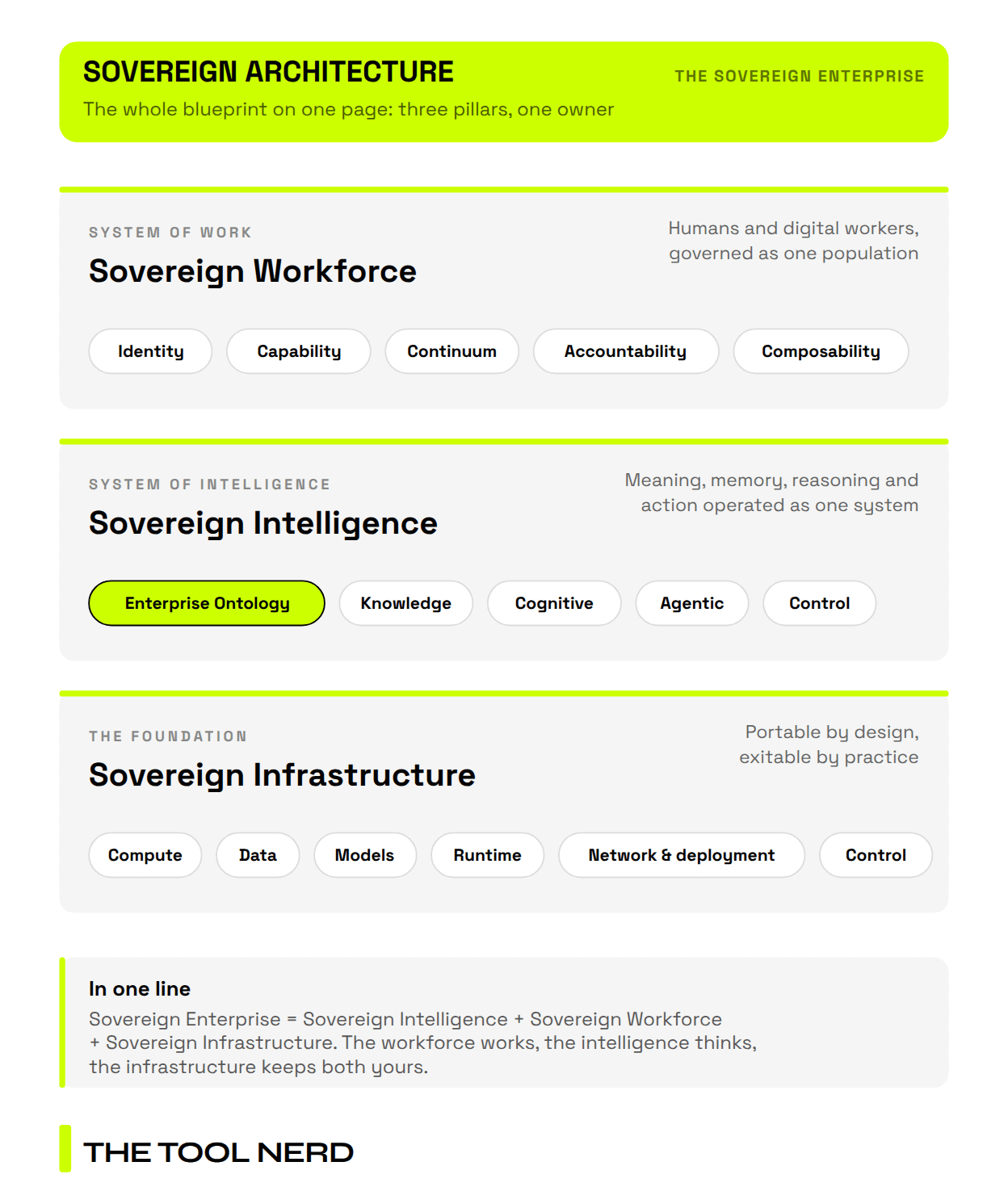
The recap fits in one line:
Sovereign Enterprise = Sovereign Intelligence + Sovereign Workforce + Sovereign Infrastructure.
Part 1 was the brain. Today it is the workforce: who does the work when some of your employees aren’t people.
One more thing to carry over: the example.
Through Part 1 we followed an e-commerce retailer that sells outdoor gear, and one of its customers, John. The retailer's digital brain knows John bought a tent yesterday, returned a sleeping bag last week, and complained about shipping times a month ago. Its reasoning layer worked out that a 20% discount on hiking boots was the best way to keep him loyal. And when an agent nearly sent that out as a 99% discount, the Control Plane caught it and blocked the send. Keep John and that near-miss in mind. Both show up again in this part.
The Sovereign Enterprise — Part 1: Why Renting AI Will Break Your Business

AI can make your company faster. But if someone else owns the intelligence behind every decision, what exactly do you own?
The Enterprise World Model: Moving Beyond Systems of Record
Before the workforce, I owe you something. Part 1 ended with a teaser about the World Model. Here’s where it fits.
Think of it as three layers. Each layer answers one question.
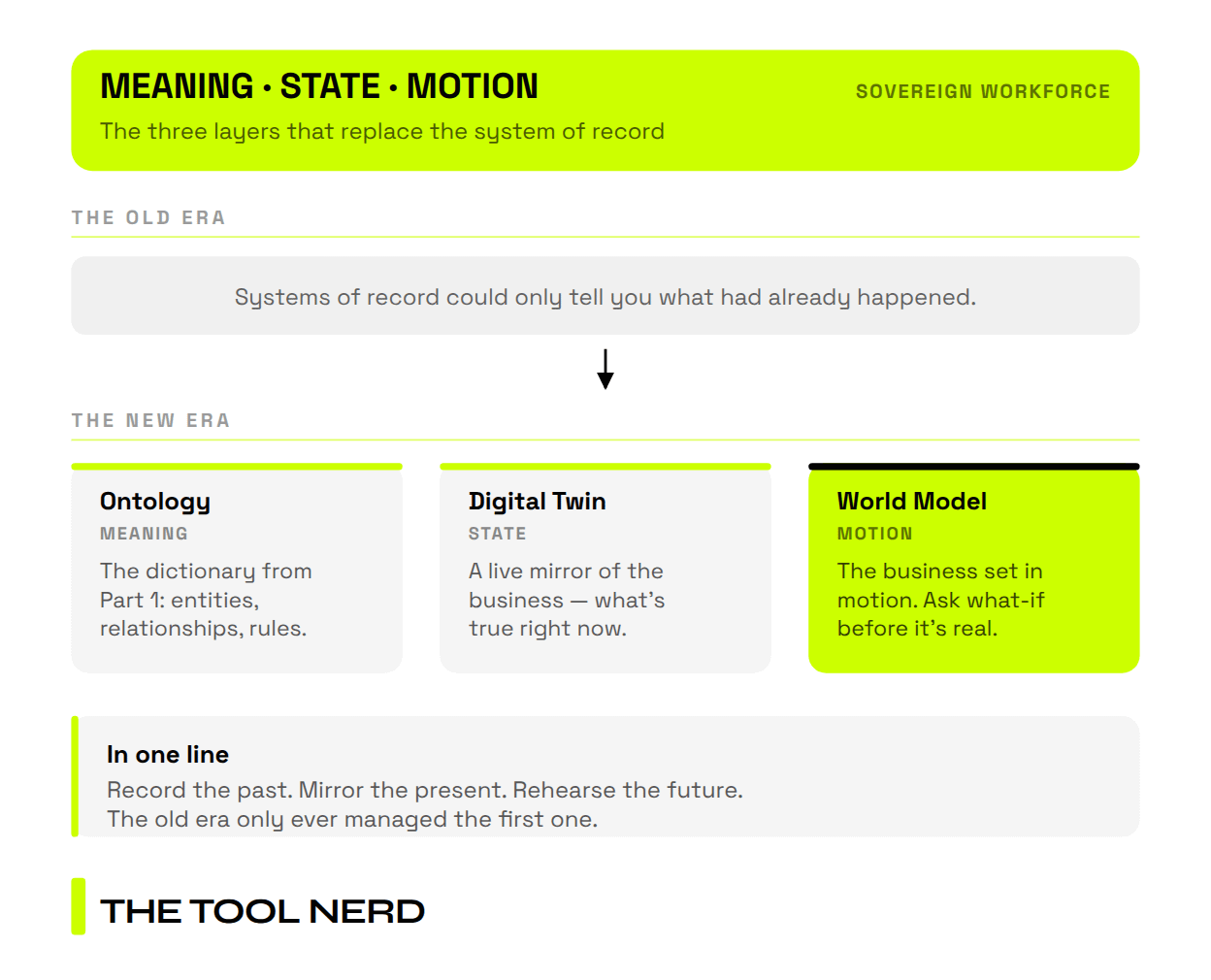
The Ontology answers: What does this mean? That’s the dictionary from Part 1.
The Digital Twin answers: What’s happening right now? It’s a live replica of the company. Google Maps is the best analogy I know. The map isn’t the road, but it shows the real traffic on the road this minute. The Digital Twin does the same for your business.
The World Model answers: what happens next if we act? It takes the current state from the Digital Twin and runs what-if scenarios on it.
Raise tent prices 10% — what happens to sales? Lose your main courier for a week — which orders slip? The twin shows the road. The World Model drives it forward.
Gilmore compresses all three into one line:
“The ontology gives the enterprise meaning. The Digital Twin gives it state. The World Model gives it motion.”
The last era of software gave us systems of record. A system of record can only tell you what already happened.
The next era runs on all three layers: an ontology for what things mean, a Digital Twin for what’s true now, and a World Model for what may happen next.
One connection back to Part 1 before we move on. Where does the Digital Twin keep all this state?
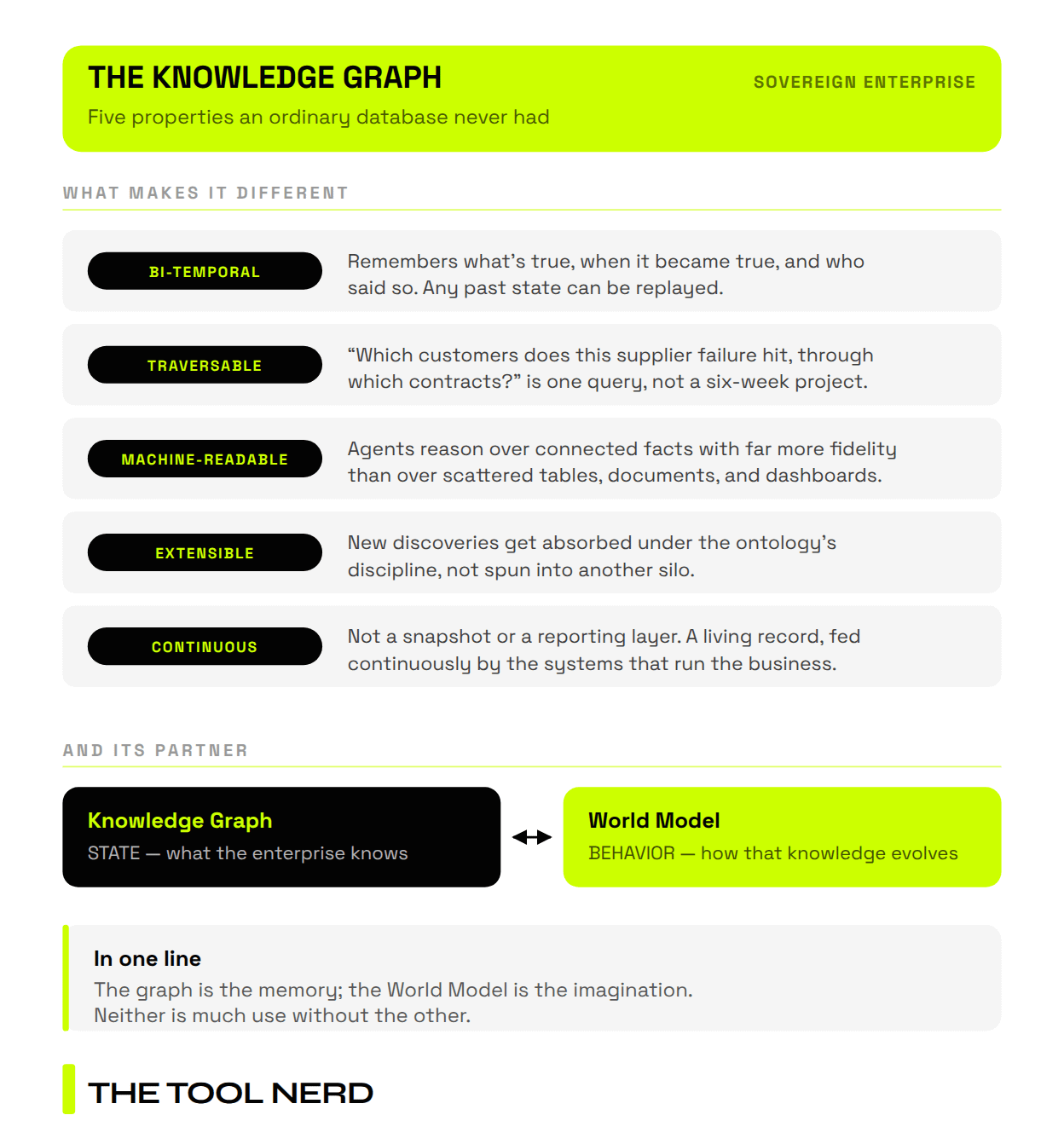
In the knowledge graph — the ontology filled in with live facts. And the graph remembers more than a database does. It knows when each fact became true, who asserted it, and how it changed over time. So, the graph holds what the company knows, and the World Model plays that knowledge forward. Memory and imagination work as a pair.
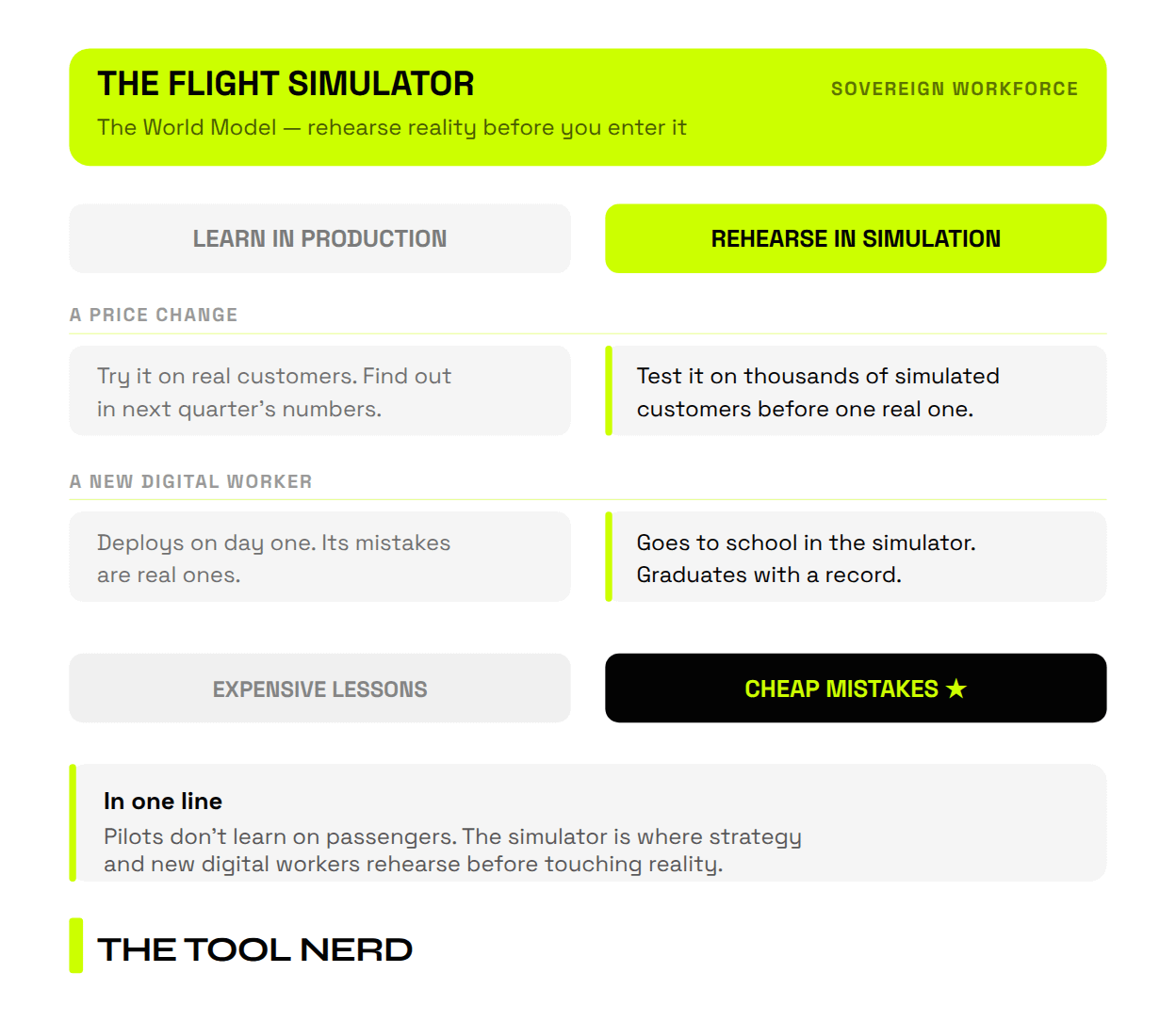
In practice, our retailer could test a price change on thousands of simulated customers before trying it on one real one. It could stress-test its supply chain against a failure that hasn’t happened yet. It could rehearse a bad quarter without living through it. Gilmore calls this the flight simulator of the enterprise. I haven’t found a better name. Pilots don’t learn when there are real passengers on the flight; they learn with simulation first.
That’s the last piece of the brain we built in Part 1. Now for the real subject of this post: the workforce that uses it.
Gilmore calls it,
Sovereign Workforce: one workforce made of human and digital workers, run under the same rules, and owned by the company itself.
Check out my previous articles here.


The Sovereign Workforce: Unifying Human and Digital Teams
So let’s meet the new kind of worker.
It takes an instruction, holds the context, applies judgment, produces an output, accepts feedback, and gets better over time.
For the first time in industrial history, there’s a category of worker that isn’t a person.
Most companies still categorize these workers as “software.”
They budget them as tools, govern them through IT, and measure them in minutes saved. This is how early industrialists were treating steam engines, as bigger water wheels. They weren’t able to see the bigger change that was coming by.
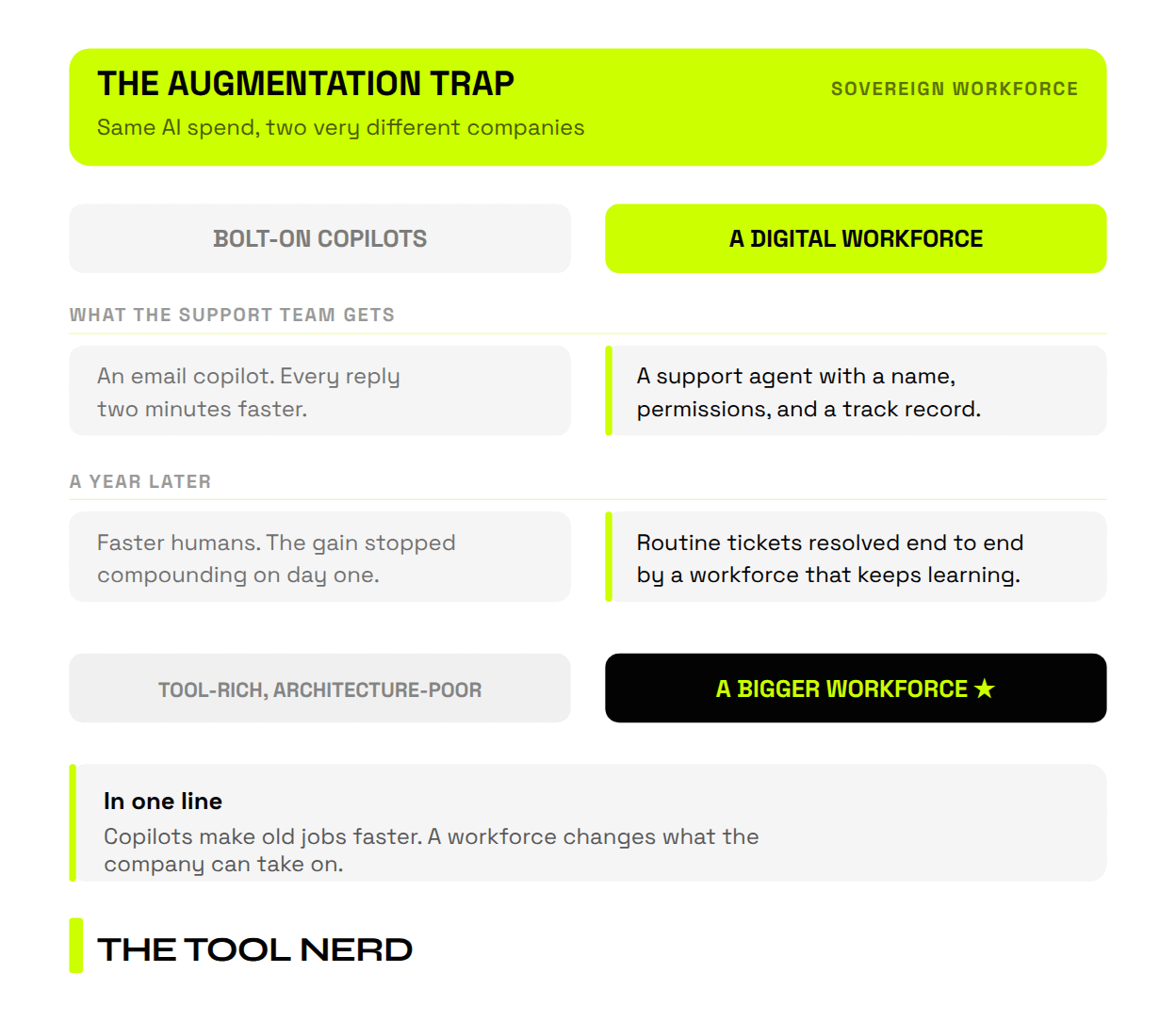
The AI Augmentation Trap: Why Copilots Aren’t an AI Strategy
Look at how most companies adopt AI today. A copilot in the developer’s editor. A summarizer in the analyst’s inbox. A drafting assistant for marketing. Vendors call this augmentation. It feels like an AI strategy:
Everyone gets a bit faster, and nothing about the org chart has to change.
This is called the Augmentation Trap. The trap is subtle because the benefits are real. Replies do go out faster. Drafts do take less time. But the gains are local, and they don’t compound. You end up becoming tool-rich but architecture-poor. Plenty of AI features, but the company still runs on human-era assumptions about jobs, departments, and approvals.
You end up becoming tool-rich but architecture-poor.
Picture two versions of our retailer. One gives its support staff an email copilot. Every reply gets two minutes faster, and that’s where it ends.
The other builds a support agent: a digital worker with a name, defined permissions, and a track record. The agent resolves the routine half of the tickets end-to-end. Humans handle the hard half.
A year later, the first retailer has faster humans. The second has a bigger workforce.
Treat Digital Workers Like Employees
In a Sovereign Workforce, every digital worker gets what any human employee has. An identity: a name, an owner, a defined job, a set of permissions.
A capability profile: its skills, and how good it has proven to be at each one.
That’s like a resume the company can verify, because every past task is on record. And accountability: every action is logged with its reason. When something goes wrong, you can reconstruct what happened and who authorized it.
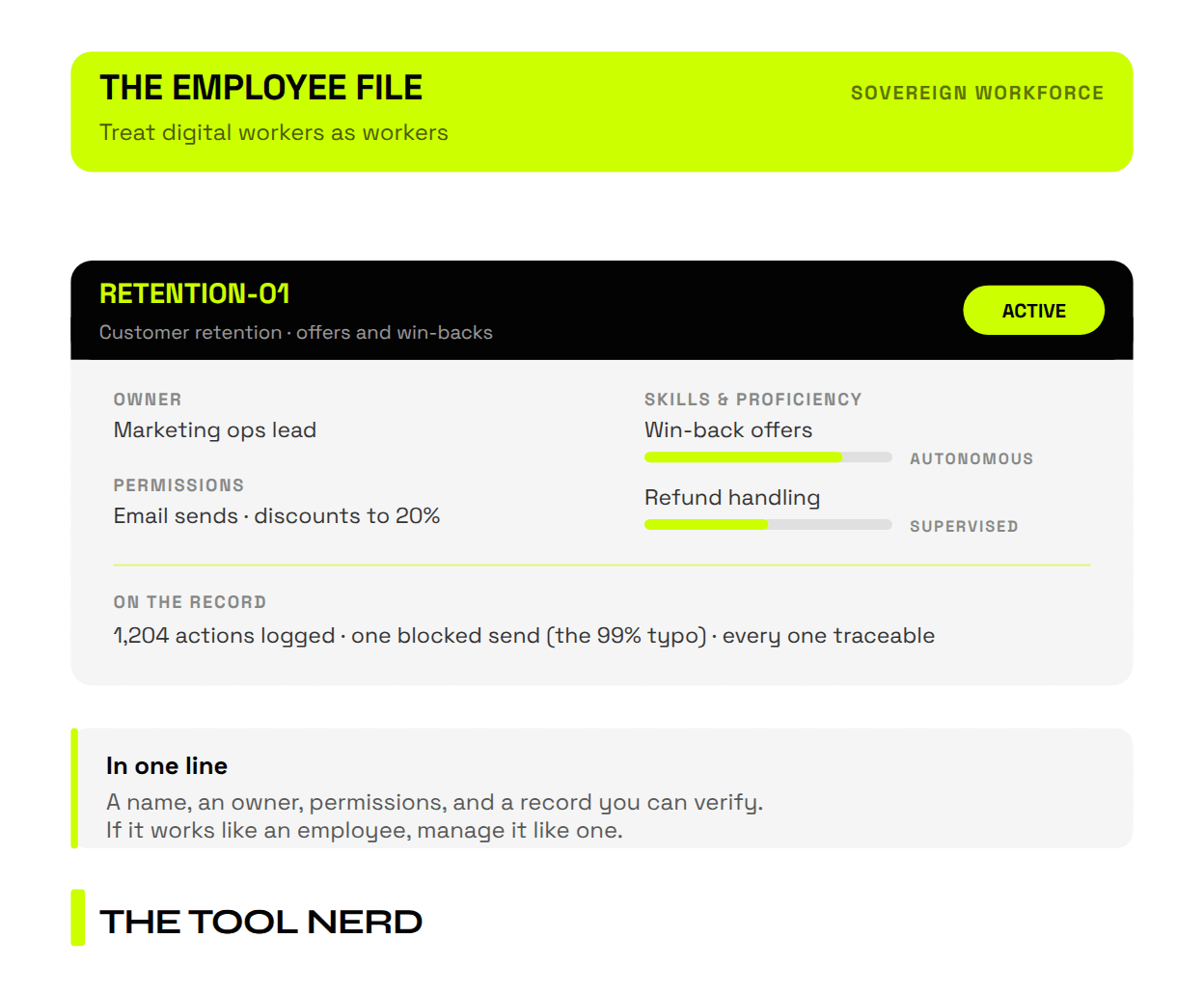
Remember the moment in Part 1 when an agent tried to send John a 99% discount and the Control Plane blocked it?
In a Sovereign Workforce, that agent has an employment file. The incident goes in it. Its autonomy on discounts gets dialed down. A human reviews its next fifty sends. It earns the trust back with a clean record.
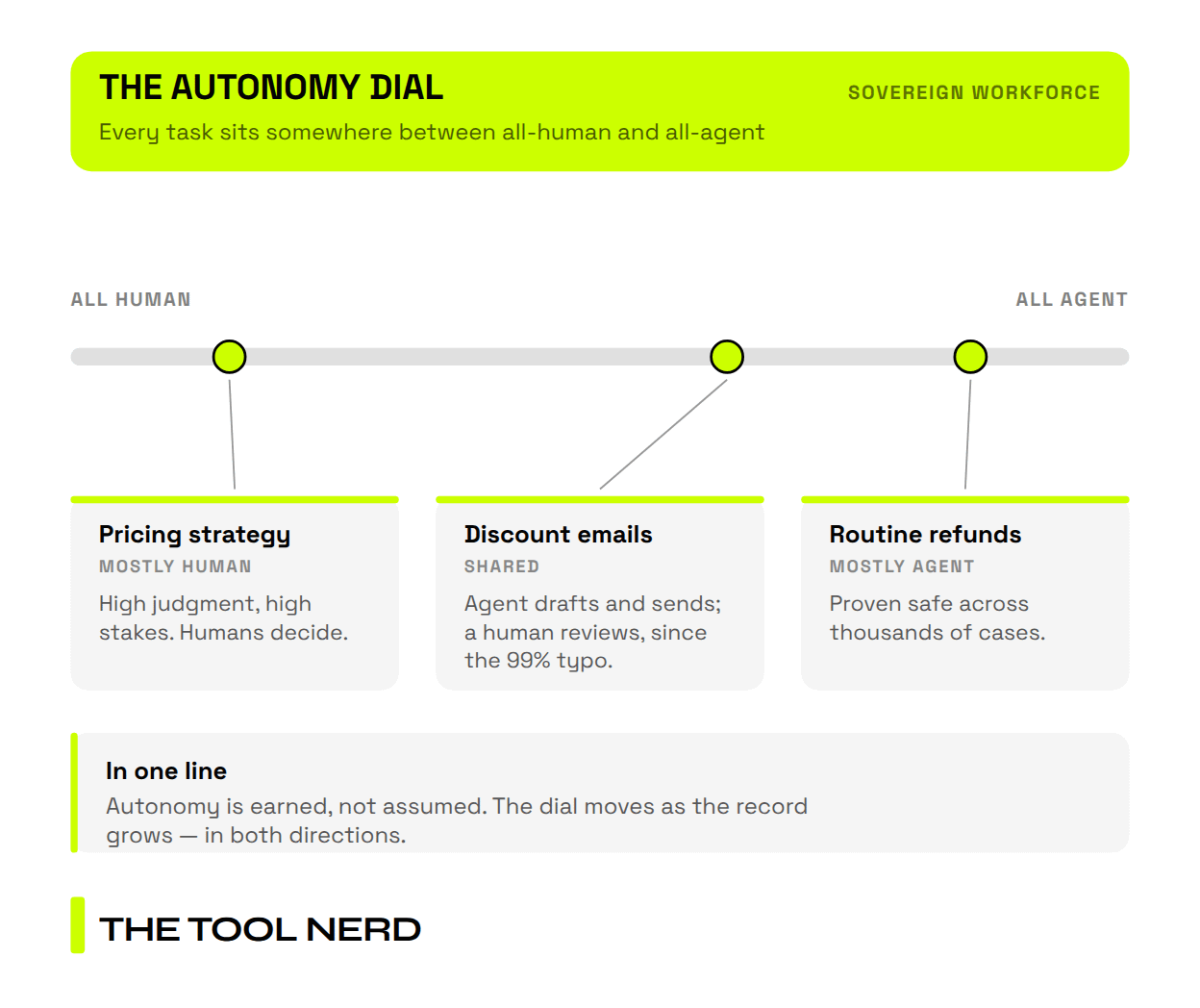
There’s one more idea here I find quietly radical: work is never assigned to humans or machines as a yes/no choice. It sits on a dial.
At one end, humans do everything. At the other, agents do. Most work lands in between, and the dial moves as evidence accumulates.
New agents start supervised. Proven agents earn autonomy. Struggling ones get pulled back. Exactly like people.
The unit of work changes too. It stops being the individual and becomes the team — usually a mixed one. Humans and agents assemble around an objective, then dissolve when it’s done.
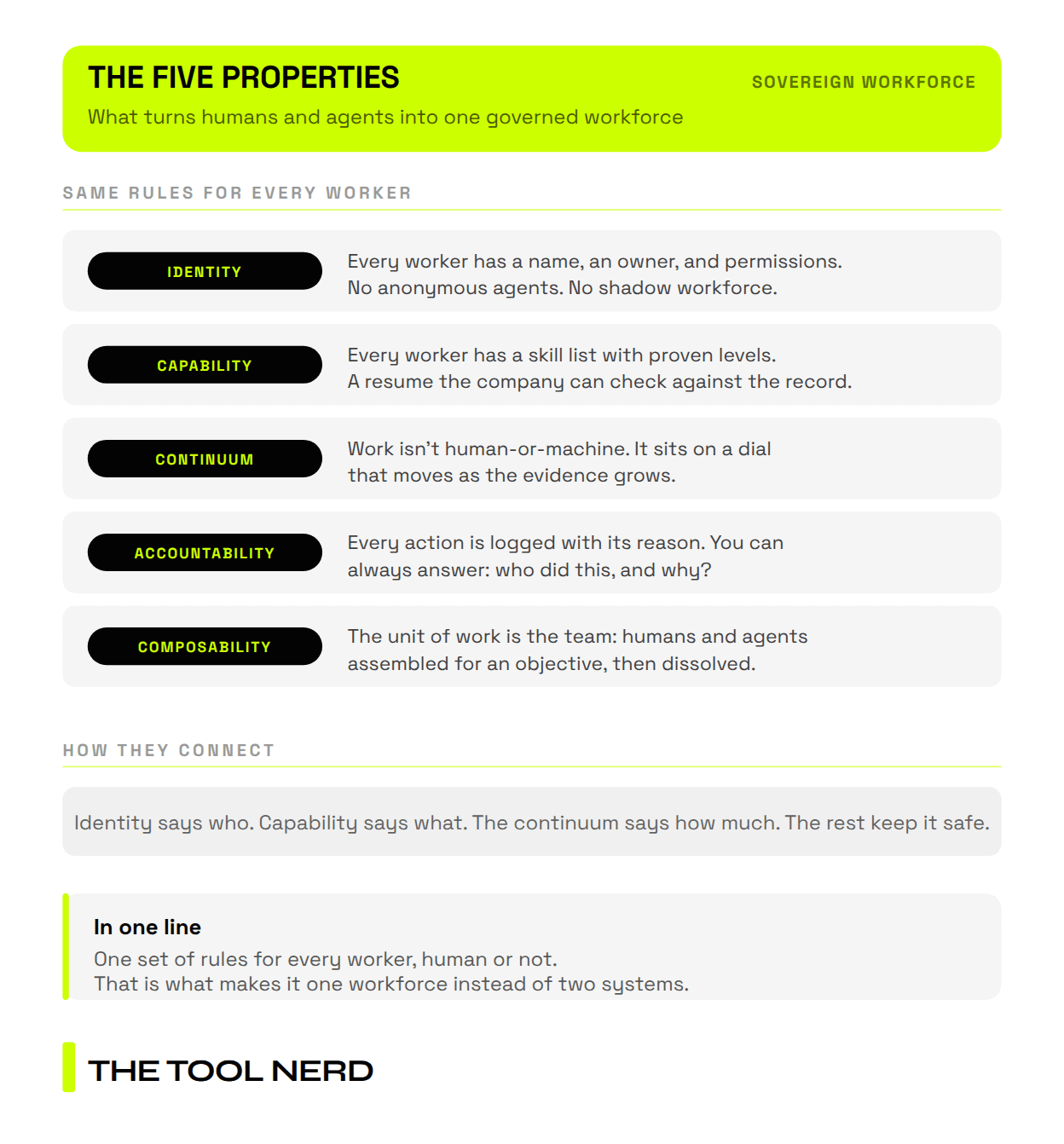
That’s the whole checklist, by the way. Gilmore calls these the five properties of a Sovereign Workforce: identity, capability, the continuum, accountability, and composability.
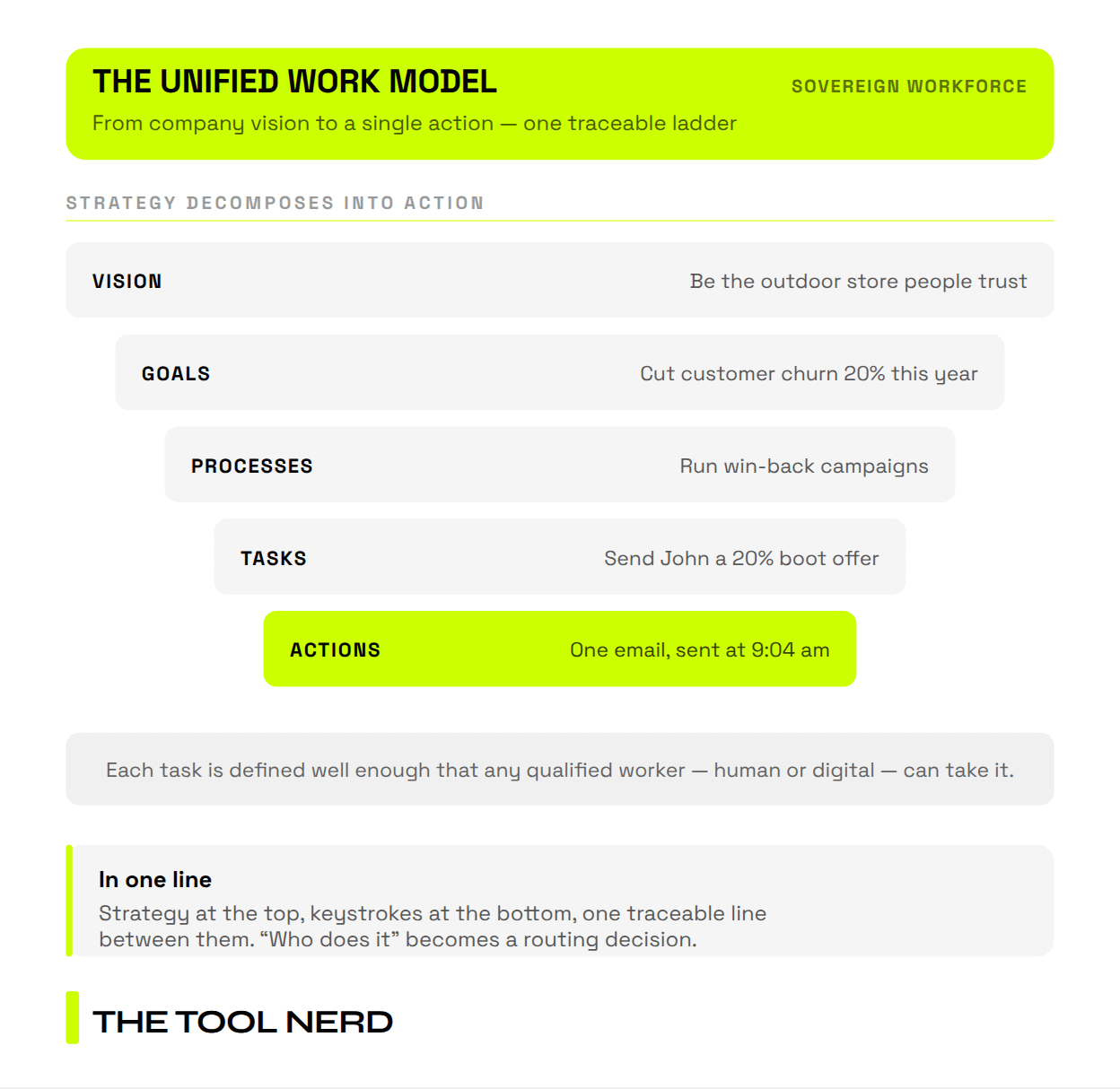
One more piece makes the routing work. The work itself gets broken down — from company vision, through goals and processes, all the way to a single task. Each task carries enough definition that any qualified worker can pick it up.
Measuring Hybrid Output: The Work Points Framework
A hybrid workforce creates an odd new problem: how do you measure work when the workers are this different? Hours measure duration, not difficulty. Headcount measures people, not work.
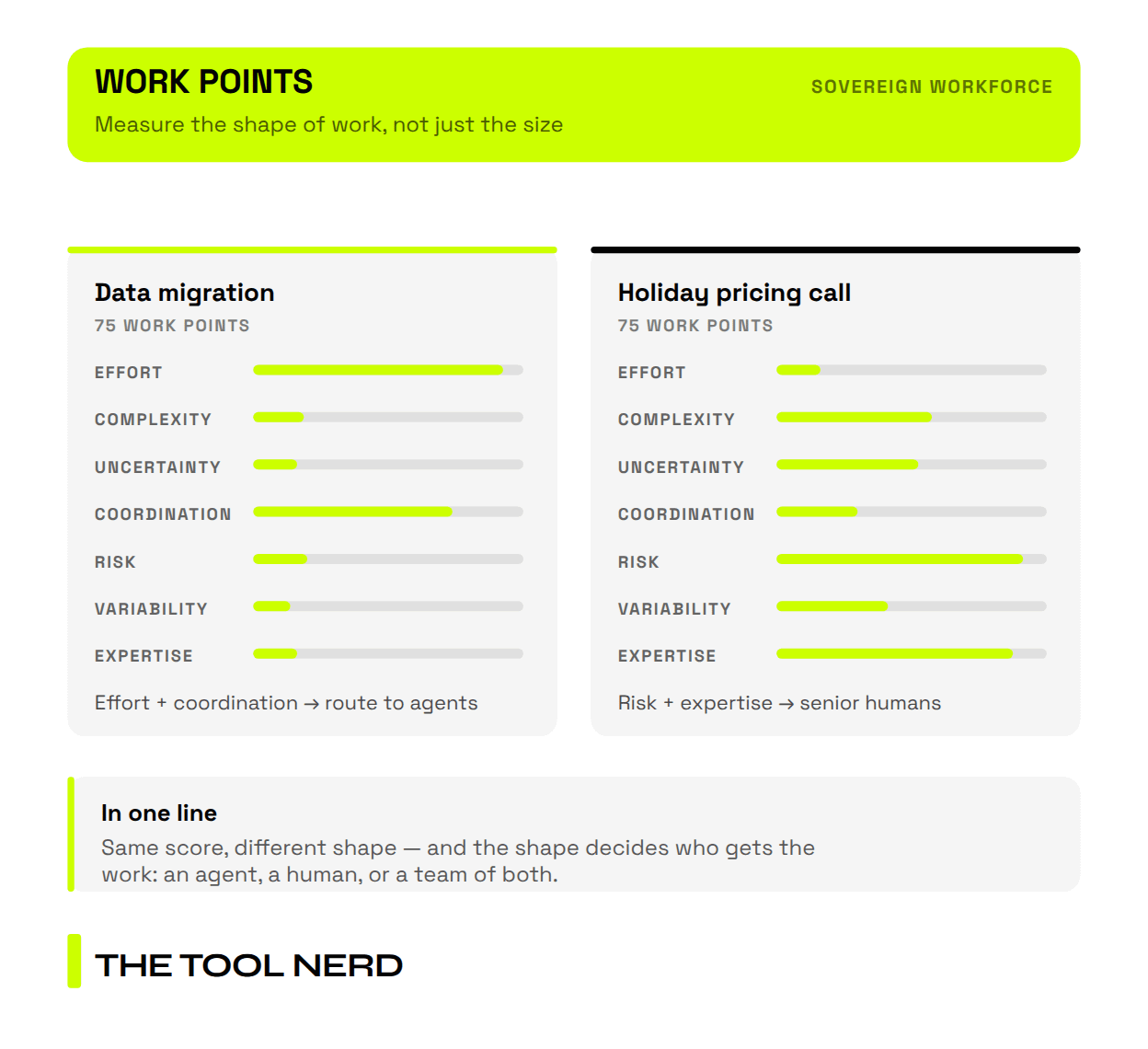
Gilmore’s answer is Work Points. The paper defines work as a multidimensional demand profile: every task gets scored on seven dimensions.
Effort is how much labor there is, regardless of how hard it is.
Complexity is how difficult it is to understand and execute.
Uncertainty is how much is unknown going in.
Coordination is how many people and systems must align to finish.
Risk is how badly failure would hurt.
Variability is how much the task changes from case to case.
Expertise is the specialized knowledge it takes to do it well — a task can be simple for an expert and impossible for a generalist.
Seven numbers instead of one, and the shape they make is the point. The paper’s own example: two tasks both score 75 Work Points, but one is dominated by risk and expertise while the other is dominated by effort and coordination. Treat them as the same task and you’ve made a management error. Score them properly and “who should do this?” stops being a turf war. It becomes a routing decision.
High-effort, low-complexity work goes to agents.
High-risk calls stay with senior humans.
The messy middle goes to mixed teams. And every completed task sharpens the record of who does what best.
The AI Software Factory: Scaling Agentic Engineering
Where does this hybrid workforce show up first? Software.
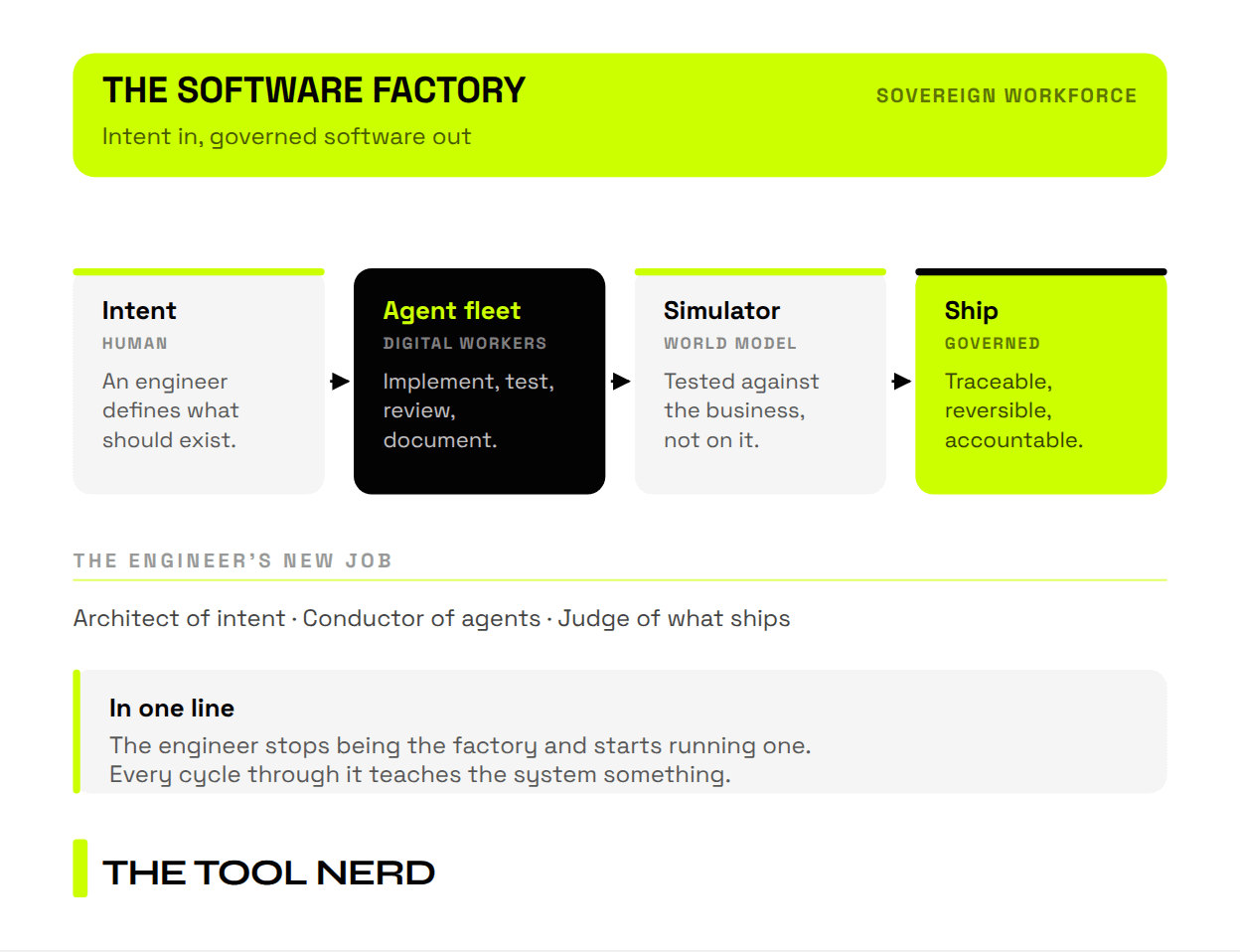
The argument: software is how a modern company encodes itself — its processes, its policies, its products. So if you own your intelligence, you must also own the machinery that turns intelligence into software. Not a coding assistant.
A software factory: fleets of specialized agents that build, test, review, document, and deploy. They work under encoded standards. Humans define the intent and judge the results. And before anything ships, it runs against the World Model. The flight simulator again — this time as the factory’s test track.
The human engineer doesn’t disappear. The job moves up a level. Less typing on every line. More deciding what should exist, directing the agents that build it, and judging what they produce. Gilmore names the discipline agentic engineering. My shorter version: the engineer stops being the factory and starts running one.
The engineer stops being the factory and starts running one.
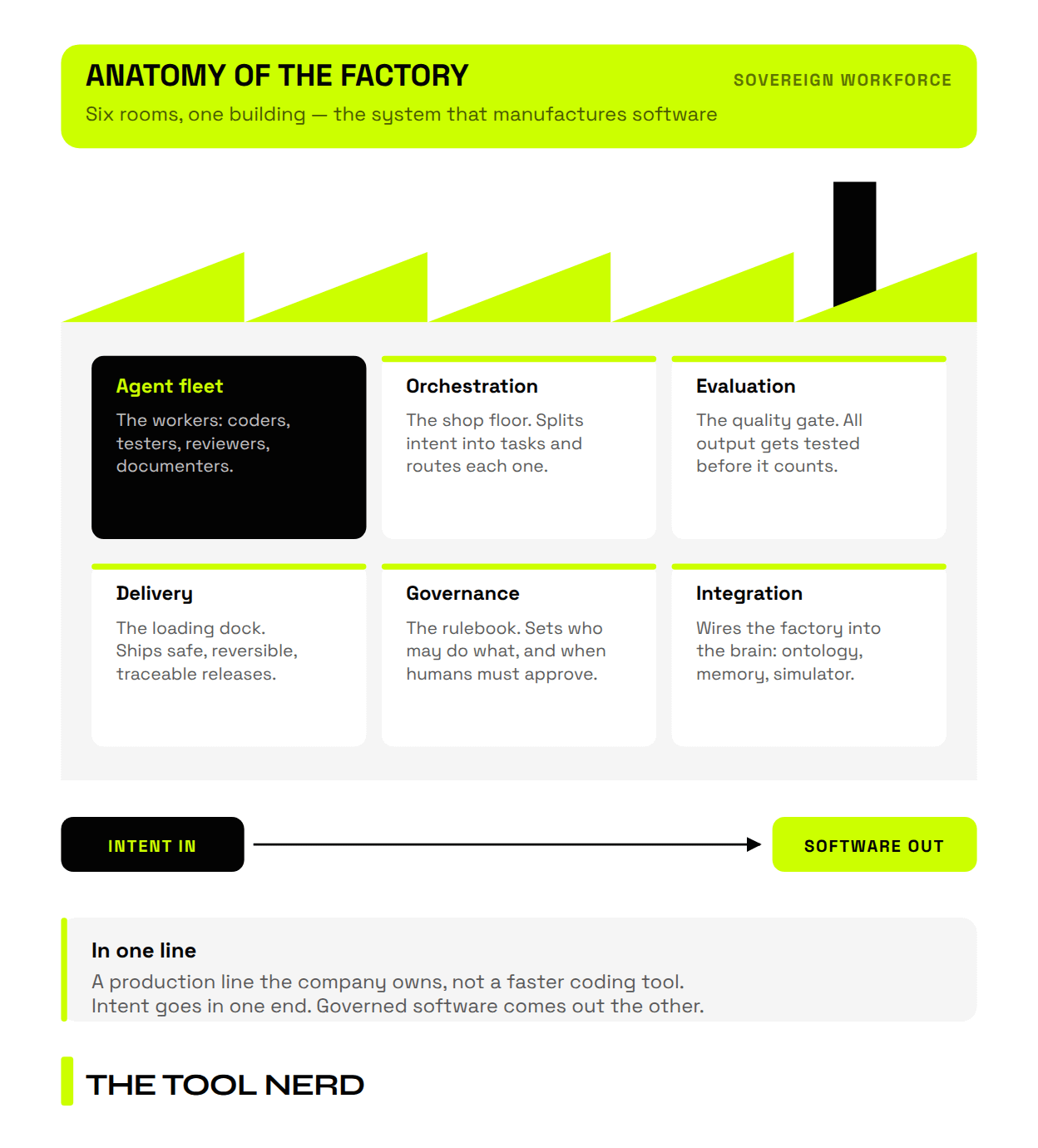
So what’s inside this factory? Gilmore lists six components. I find them easier to picture as rooms in one building.
The agent fleet is the workers.
Orchestration is the shop floor that splits intent into tasks.
Evaluation is the quality gate.
Delivery is the loading dock.
Governance is the rulebook.
And the integration room wires the whole building into the brain from Part 1 — the ontology, the memory, the simulator. Intent walks in one door. Governed software walks out the other.
Building Enterprise Moats with an Owned AI Workforce
A productivity feature delivers its gain once. A Sovereign Workforce learns.
Every completed task sharpens the record: which workers handle what best, where autonomy is safe, where human judgment stays non-negotiable. Run that loop for five years. You now know things about running a hybrid workforce that a competitor can’t buy, because the knowledge only comes from running one.
The workforce is going hybrid either way. The only question is whether yours will be designed or accidental.
Part 3 closes the series with the ground all of this stands on: Sovereign Infrastructure. Why the hyperscalers are the last landlords, and what owning your foundations actually takes.
References
[1] Eric Gilmore. “The Sovereign Enterprise: A Blueprint for the Cognitive Revolution.” sovereignenterprise.org. July 2026.
[2] The Tool Nerd. “The Sovereign Enterprise — Part 1: Why Renting AI Will Break Your Business.”