

I used to spend a lot of time confused about where I fit.
I’m not a traditional developer. I don’t write production code all day. But I build products. I can conceptualize an idea and materialize it into a working prototype faster than most. But here’s the reality: most of the ideas I build never see the light of day. They don’t ship.
For a long time, the question I dreaded most in organizational planning was, “Where do you fall in the org chart?”
If you’re a builder who spans multiple disciplines, you’ve probably felt this tension. The way tech organizations were built over the last two decades—rigid silos of Product, Design, and Engineering—is fundamentally incompatible with how software is built today.
Recently, Boris Cherny (the creator of Claude Code) posted an observation that perfectly encapsulated my dilemma. He foresees that future roles might be categorised into five distinct “archetypes” [1].
Your job title is dead.
If you would like to read my previous articles, check them out here:


The 5 Archetypes Replacing Software Engineering and Product Roles
Boris Cherny is the creator of Claude Code. He recently posted an observation about how his team at Anthropic operates — that engineering, product, design, and data science are melting into a new kind of role. When he looks at the Claude Code team, he doesn’t see front-end devs or UX researchers. He sees five archetypes [1].

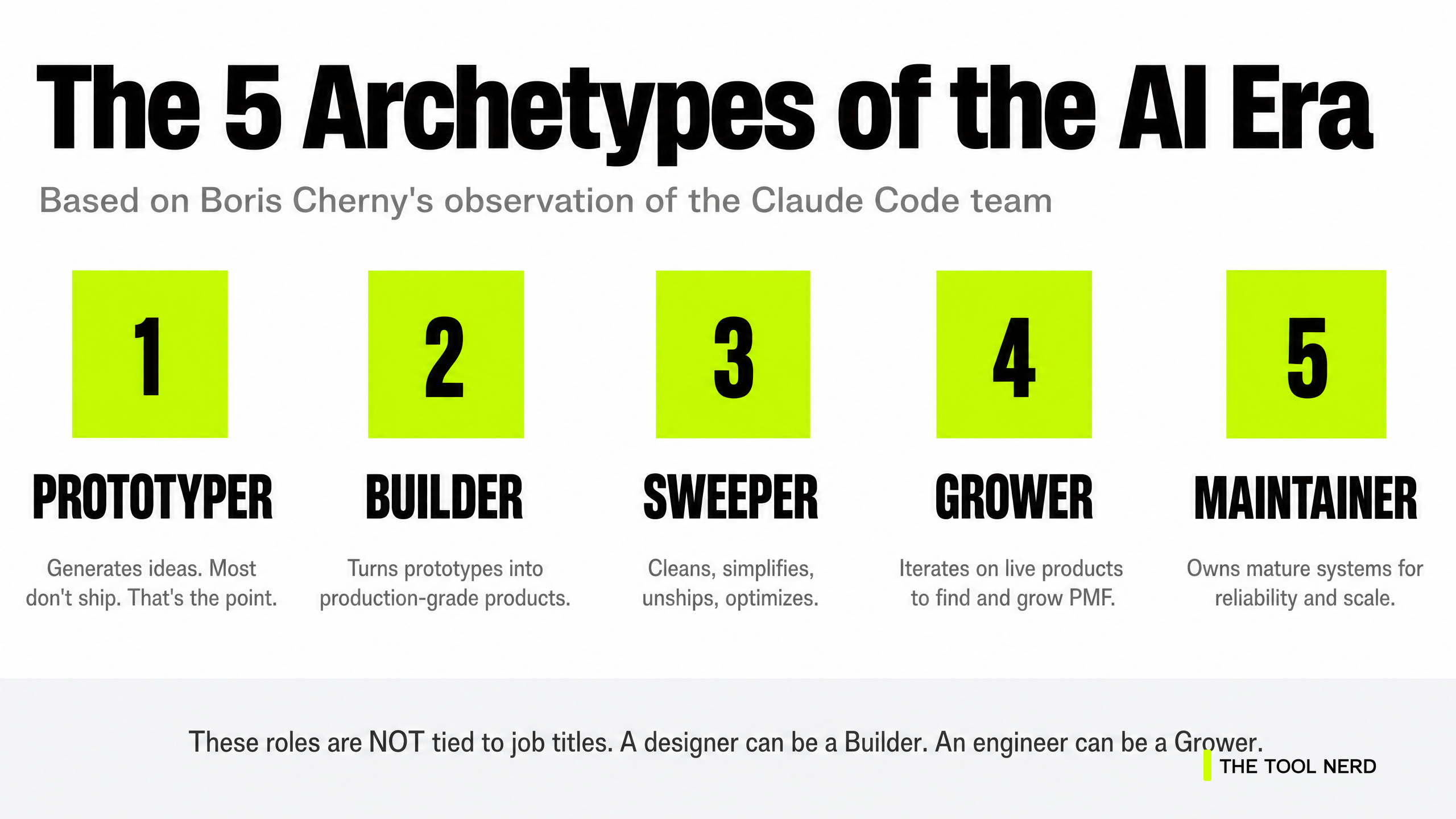
The Prototyper: Comes up with brand new ideas. Churns out dozens of concepts, most of which don’t ship.
The Builder: Quickly turns a prototype or idea into a production-grade product or infrastructure.
The Sweeper: Cleans up the UI, simplifies the codebase, unships dead features, and optimizes performance.
The Grower: Takes a product that has found its footing and iterates relentlessly to improve Product-Market Fit.
The Maintainer: Owns a mature system, ensuring it remains secure, reliable, fast, and efficient as it scales.
Reading that list was a relief. My “problem” — that I prototype fast but most of my ideas don’t ship — isn’t a bug. It’s the exact, necessary definition of the Prototyper archetype.
The critical nuance Cherny points out is that these roles are entirely decoupled from job functions. Across Anthropic, some designers are Prototypers. Some are Builders. Some engineers are Sweepers; others are Growers. Many people span two or even three of these roles simultaneously. The labels on our LinkedIn profiles are lagging indicators of a reality that has already shifted.
How AI Coding Assistants Inverted the Product Development Process
Now here is where it gets interesting. Cherny’s framework explains who the roles are. AJ Ambrosino, the Engineering lead for OpenAI’s Codex, explains why those roles exist at all — and why the old ones don’t.
In a recent conversation with Lenny Rachitsky, Ambrosino laid this out plainly. The old product process was built on a single, immovable assumption: building things is expensive. Because coding took months, teams had to de-risk everything upfront with PRDs, user research, and endless meetings asking, “Should we build this?” [2]


That assumption is dead. Implementation is now cheap.
The hard work has shifted. It’s no longer about planning; it’s about synthesis. The new question is not whether to build it, but:
“Of all the prototyped attempts at this idea, what’s the best one, and what do we go all-in on?”
When the cost of generating code drops to near zero, the value of a “pure coder” drops with it. The value shifts entirely to judgment. As I wrote in The Token Test, the elite engineers of 2026 aren’t the ones who write the most code — they’re the ones who architect systems so clearly that AI executes them perfectly on the first pass.
Your Job Title Is Irrelevant — Your Time Allocation Defines Your Role
So if you aren’t defined by your title, what defines you?
Ambrosino offers a brutal, clarifying diagnostic: your role is defined by the average of what you spend your time on.
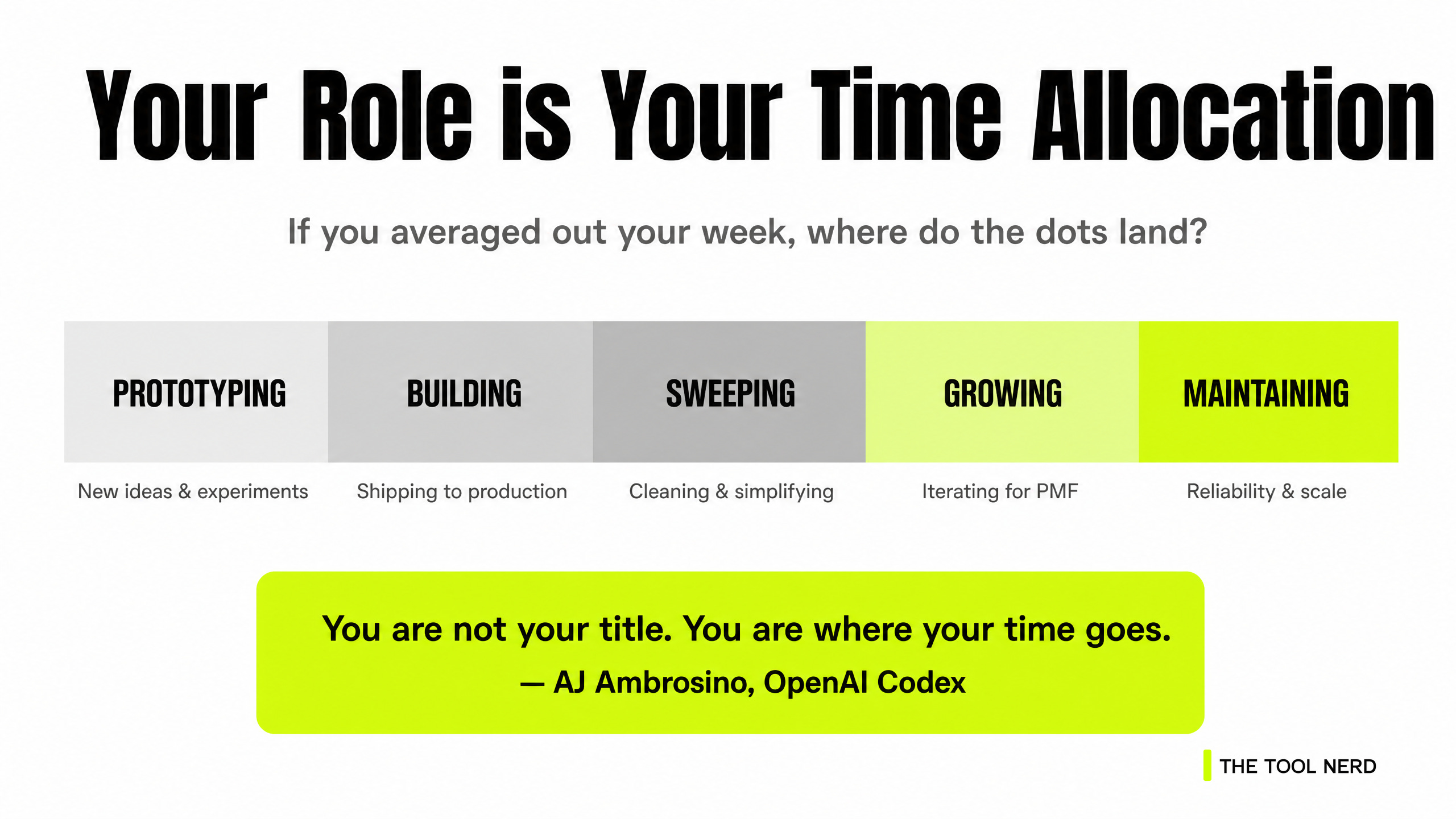
If you average out everything you do in a forty-hour week, where do the dots land? If you spend sixty percent of your time iterating on features to drive engagement, you aren’t a “Full Stack Engineer.” You are a Grower. If you spend your time testing wild ideas that usually fail but occasionally redefine the product, you are a Prototyper.
Designers are writing code. Engineers are doing design. PMs are shipping. You are not your title. You are where your time goes.
Why the Future of Tech Teams Needs Full Stack Problem Solvers, Not Specialists
Cherny’s framework is accurate for a well-funded team like Claude Code. He notes that a pre-PMF product needs people strong at Prototyping, Building, and Sweeping, while a mature product needs Sweepers, Growers, and Maintainers.
But having spent my career in startups, I’ll add a necessary complication.
In the startup world, the future isn’t about finding five separate people to fill these archetypes. The future belongs to the Full Stack Problem Solver — the hybrid builder who can wear two or three hats simultaneously.
We don’t need a Prototyper and a Builder. We need a Prototyper who understands enough about production hardening to hand off a clean build.
We need a Builder who understands business metrics well enough to act as a Grower.
This requires a fundamental shift in how we build our careers. And here I want to be precise, because this is different from the “T-shaped” model people have been talking about for years.
The T-shape assumes breadth is secondary — a nice-to-have layer on top of your core expertise. What I am arguing is different. In the AI era, your adjacent skills are not optional extras. They are what make your core strength actually deployable in the real world.
As I wrote in The Token Test, the most valuable engineers of this era are what I called the Business Engineer — someone with deep technical capability combined with genuine business acumen. They understand which metric the feature they are building is going to move. They have a taste for design without needing to be the designer. They know the product well enough to architect solutions that don’t just work, but actually drive growth.
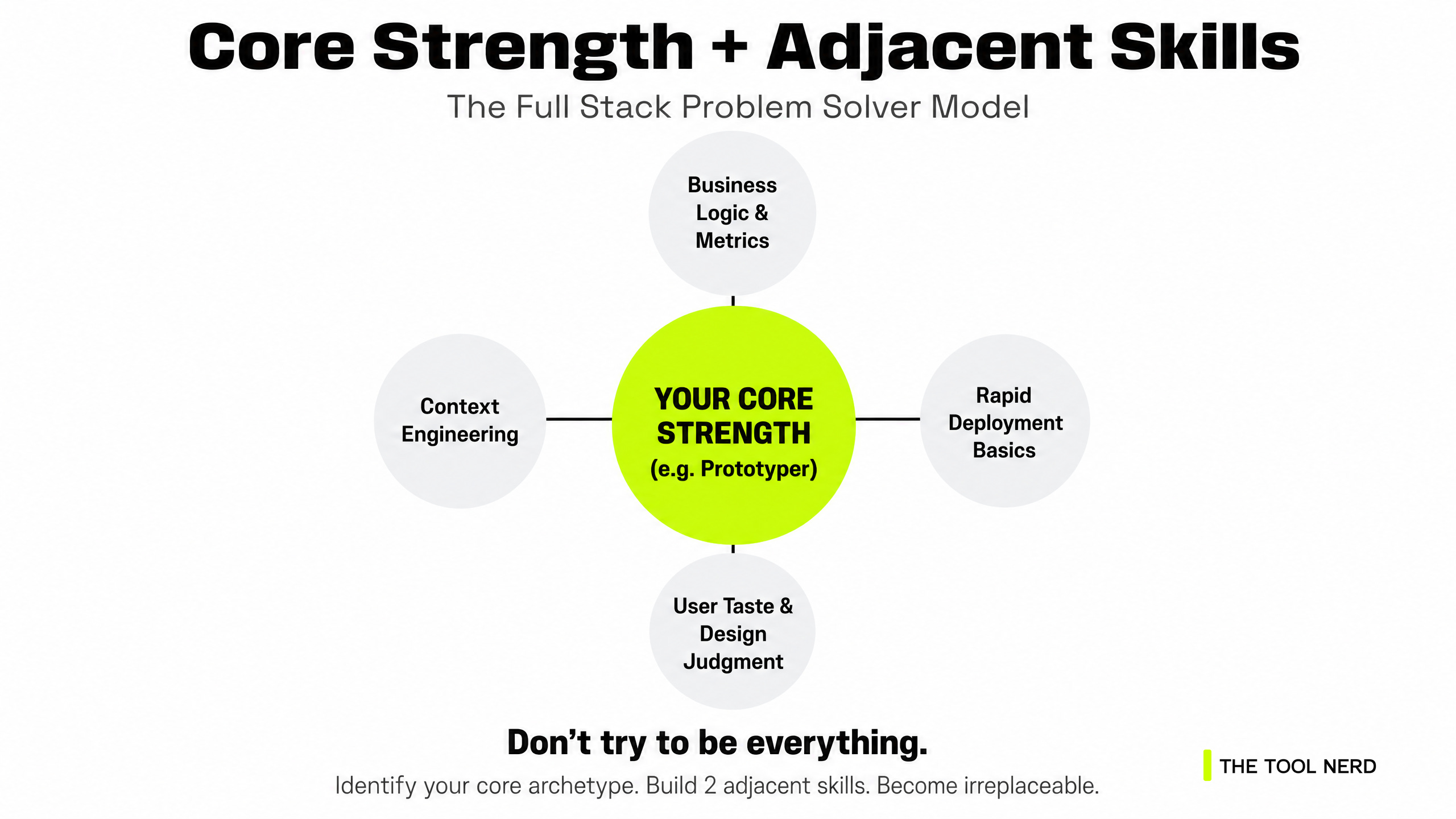
That is the model. Know your archetype deeply. Then build the adjacent skills that make you dangerous across the full problem space — not a generalist, not a pure specialist, but someone who can operate from their core strength and reach far enough into adjacent territory to solve real problems end to end.
If your core is Prototyping, you don’t need to become a Maintainer. But you do need to understand business logic, rapid deployment, and what good design feels like. That combination is what makes you irreplaceable.
Why Taste and Systems Thinking Are the Highest-Leverage Skills in the AI Era
This brings us to the ultimate differentiator in the role collapse era: Taste.
We usually think of taste as aesthetics — knowing what looks good. But in an era where AI can generate infinite variations of a UI, aesthetics are commoditized. Real taste, as the Codex team defines it, blends aesthetics with systems thinking.
Taste is the ability to answer the hardest question in tech right now: “If we can build anything, what should this be?”
It’s knowing the direction, the theme, and how to present an idea. It’s the Forward Deployed Engineer who sits on a messy factory floor, ignores the client’s request for a dashboard, and realizes they actually need an automated routing system. Taste is not a soft skill. It is the highest-leverage skill left.
How to Identify Your Archetype and Build Adjacent Skills to Stay Relevant
The tech industry is in an awkward transition. HR departments are still posting jobs for “Senior React Developers,” but engineering leaders are quietly looking for Builders and Sweepers.
Here’s how to position yourself:
Look at your last month of work. Where did your dots land? Own that archetype — even if it doesn’t match your official title. Then identify the two adjacent skills that would make you significantly more valuable in that archetype. If you’re a Builder, learn the product metrics that make you a Grower. If you’re a Maintainer, learn the architectural patterns that make you a Sweeper.
The role collapse isn’t something to fear. For years, builders who didn’t fit neatly into “Software Engineer” or “Product Manager” boxes were treated as organizational anomalies. Today, those anomalies are the ones building the future.
Figure out which archetype you are. Build your adjacent skills. Stop worrying about the org chart.
References
[1] Boris Cherny on X (June 28, 2026)
[2] Lenny Rachitsky on X: Takeaways from Codex Lead AJ Ambrosino (2026)