


How I Discovered the FDE Role
I had never heard of a Forward Deployed Engineer until I joined my current organization. The term popped up casually during a discussion with the founders, and I was intrigued. What exactly was this role? Why were they talking about it so seriously?
I started digging, and then I came across this recent tweet by Mike Fishbein that was so good.

After 40+ forward deployed engineering engagements, Fishbein had distilled the role down to its essence: FDEs are three jobs in one.
They figure out where in the business to build (consulting), what to build (product), and how to build it (engineering). But more importantly, he nailed the real bottleneck: coding is now the easy part.
Everything before the code—extracting context from clients, understanding their workflows, creating structure from chaos—is the hard part.
This wasn’t just another tech role. It was a structural response to the messy reality of enterprise AI.
Check out my previous articles and subscribe to keep updated with interesting insights on AI :


Why This Matters Now
If you are an engineer deciding where to invest your career in 2026, or a founder trying to figure out why your AI deployments keep stalling, you need to understand the Forward Deployed Engineer.
But here’s what makes this role particularly relevant right now: the emergence of SovereignAI.
As data sanctity and security become paramount, organisations are increasingly demanding full ownership of their AI stack—including their proprietary data, models, and organisational secrets. They don’t want their workflows locked into someone else’s cloud. They want control. They want sovereignty.
This shift fundamentally changes who gets hired and how. It’s no longer enough to have a generic “AI solution.” You need someone who can navigate the complexity of building AI systems that respect data boundaries, comply with regulations, and integrate seamlessly with legacy infrastructure. That someone is the FDE.
Two Paths Into the FDE Role
The beauty of the FDE role is that it’s not gatekept by a single background. There are two distinct paths in.
If you’re a generalist, you can transition into the FDE role if you can become genuinely good at AI and technology. You don’t need a decade of engineering experience. You need to understand how AI works, how to prototype quickly, and how to communicate technical concepts to non-technical stakeholders. Your business intuition becomes your superpower. You already understand how organisations work. Now learn the tech.
If you’re a techie, the path is different but equally viable. You can learn about the business world, real-world problem-solving, and how to think beyond coding in silos. Most engineers spend their careers optimising for technical elegance. FDEs optimise for customer outcomes. That’s a mindset shift more than a skill gap. Learn to ask “why” before “how.” Understand the business impact of every line of code. Transition from builder to builder-for-a-purpose.
Both paths converge at the same place: someone who can navigate ambiguity, own customer outcomes, and bridge the gap between what’s technically possible and what’s business-critical.
Understanding the FDE: The Three Jobs in One
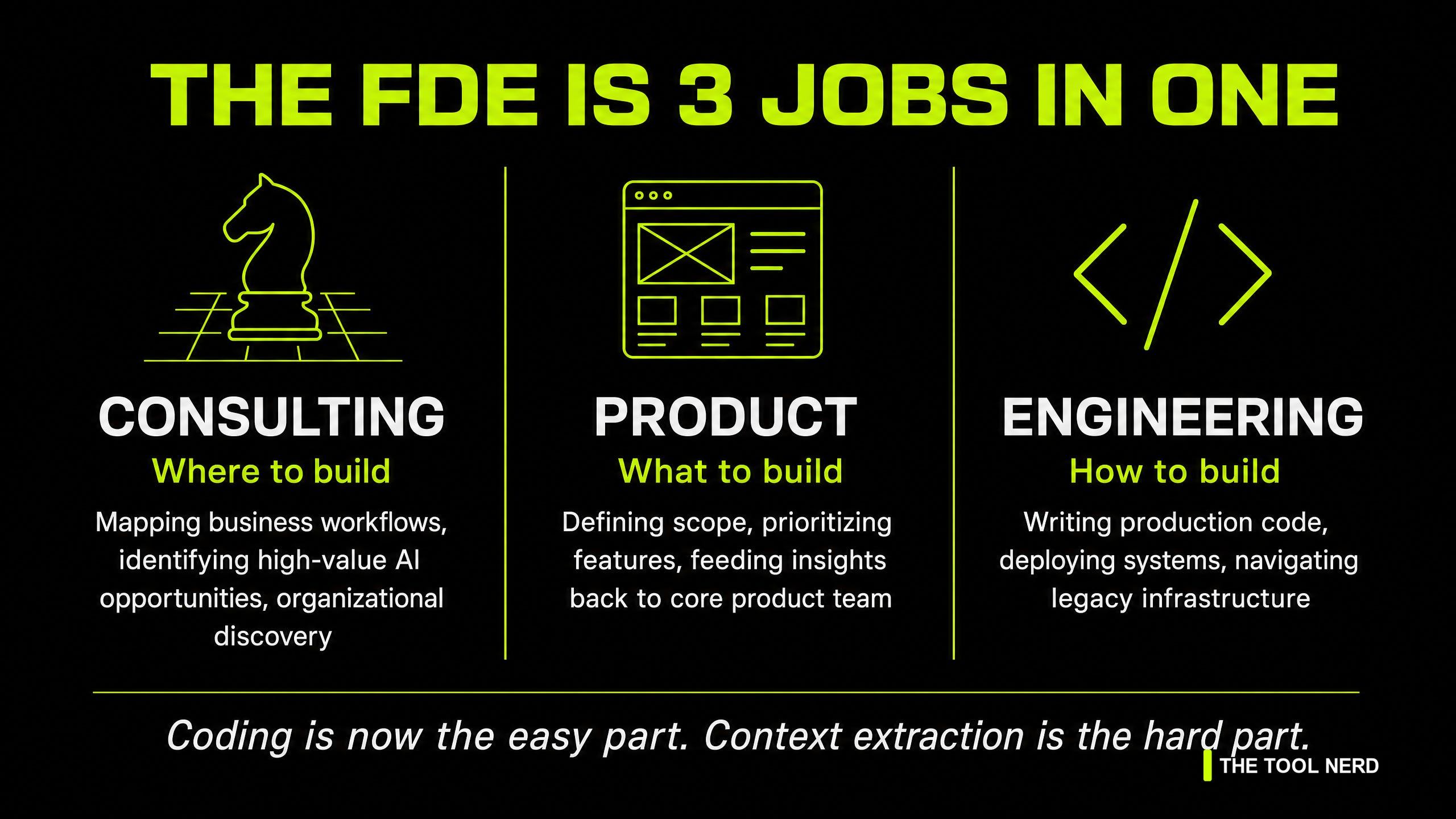
The term “Forward Deployed Engineer” sounds like a purely technical role. It’s not. As Fishbein points out, an FDE is actually three distinct jobs wrapped into one high-stakes position [1].
First, they act as consultants. They figure out where in the business to build. They map real-world workflows, talk to stakeholders across different departments, and identify the highest-value opportunities for AI integration. They do the organisational discovery that traditional product teams rarely have time for.
Second, they act as product managers. They decide what to build. They define the scope, prioritise features, and crucially, feed their field insights back to the core product team at headquarters.
Third, they are engineers. They figure out how to build it. They write production-grade code, deploy systems, and navigate the labyrinth of legacy infrastructure and fragmented data pipelines that define modern enterprise environments.
Coding is now the easy part, thanks to tools like Claude Code and Cursor. The hard part is everything before the code. It is extracting context from clients who have it scattered across people and tools, and creating context when it doesn’t exist at all.
The Origin Story: How Palantir Invented the FDE Role
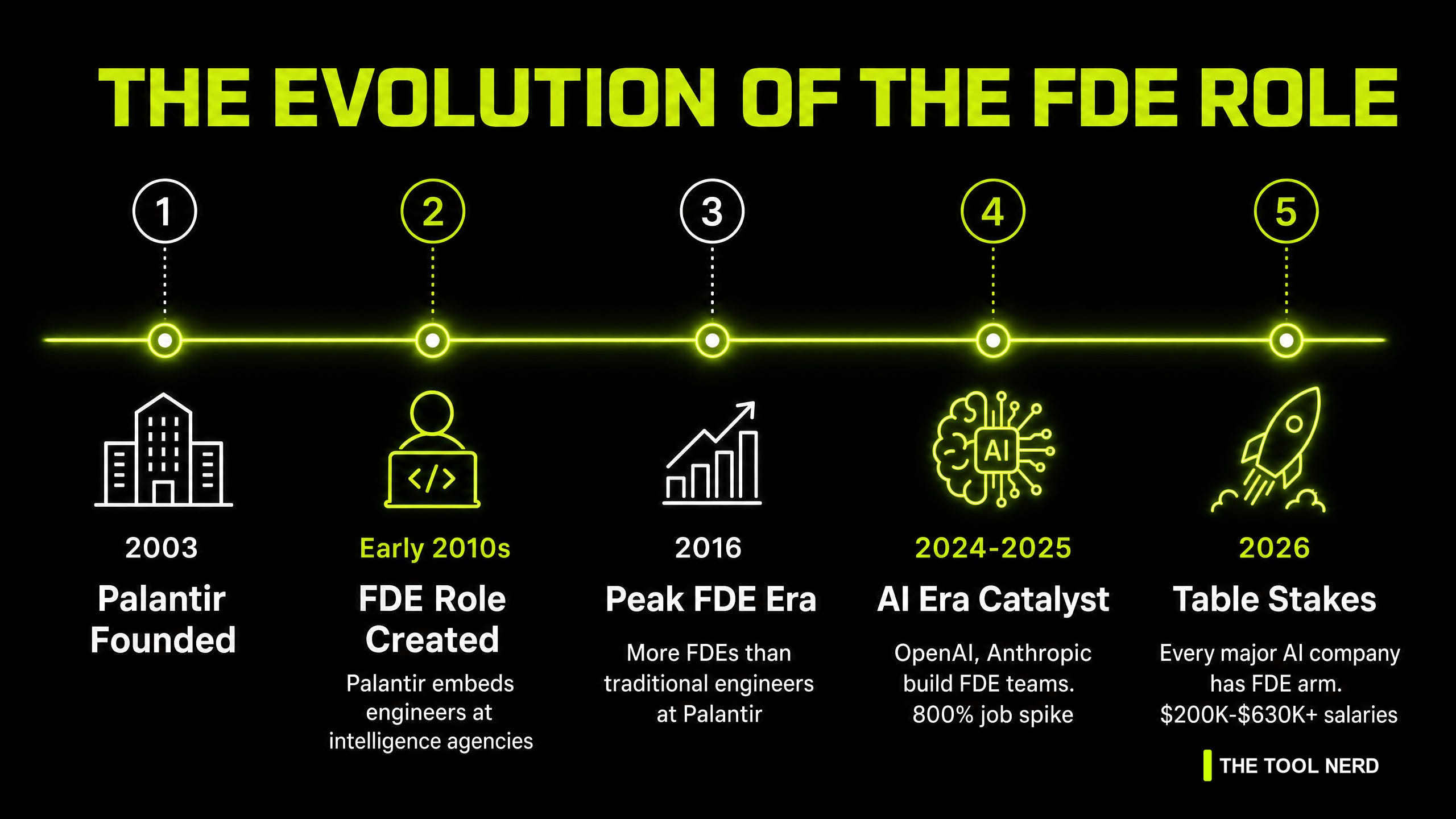
The FDE role didn’t emerge from the AI boom. It was born out of necessity in the early 2010s at Palantir Technologies [2].
Palantir faced a problem that traditional software companies never encounter. Their early customers were intelligence agencies. These organisations couldn’t openly share their data, their workflows were constantly changing, and they often couldn’t clearly explain what they needed.
Traditional product development—gathering requirements, building in isolation, and shipping a final product—was useless.
So Palantir did something unusual. They embedded their engineers directly inside customer environments. These engineers learned by observing, experimenting, and building in real time. Palantir called these early embedded engineers “Deltas.”
This created the “gravel road to paved highway” feedback loop. FDEs would build rough, custom solutions for specific customers (the gravel roads). The core engineering team back at HQ would study these solutions, find patterns across multiple clients, and build standardised features into the main platform (the paved highways).
The model worked so well that by 2016, Palantir had more forward-deployed engineers than traditional software engineers [2]. Today, Palantir’s Q1 2026 results show 85% year-over-year revenue growth and 133% growth in U.S. commercial business—proof that the FDE model is not just viable, but highly profitable [3].
Why Forward Deployed Engineers Are Exploding in 2026
The Enterprise AI Bottleneck
Fast forward to 2026. Why are FDE job listings spiking by 800%? [4]
Because AI systems face the exact same challenges Palantir faced fifteen years ago. AI is complex, undefined, and highly contextual. No single solution works everywhere, and most companies struggle to define exactly what they need from AI.
A 2025 MIT report found that about 95% of enterprise generative AI pilots showed no measurable profit and loss impact. The researchers traced this failure not to weak models, but to flawed integration. The bottleneck was not model capability but the gap between a polished demo and a working integration inside legacy systems, change advisory boards, and compliance regimes that move at their own pace [3].
When you deploy a deterministic SaaS product, you configure it. When you deploy an AI agent, you have to adapt it to the probabilistic, judgment-heavy reality of human workflows.
OpenAI’s $4 Billion Bet on Deployment
OpenAI realized this early. On May 11, 2026, they announced the OpenAI Deployment Company—a major structural bet on the FDE model [5].
The company launched with more than $4 billion in committed capital, led by TPG with co-lead founding partners including Advent, Bain Capital, and Brookfield. In connection with the launch, OpenAI acquired Tomoro, an Edinburgh-based AI consulting and engineering firm, bringing approximately 150 experienced Forward Deployed Engineers and Deployment Specialists to the OpenAI Deployment Company from day one [5].
This is not a side project. OpenAI’s enterprise customers already account for more than 40% of OpenAI’s revenue, with the company expecting parity with consumer revenue by year-end 2026. That mix only holds if pilots convert to production, and OpenAI has concluded that conversion does not happen without engineers on the ground [3].
The Broader Industry Pattern
OpenAI is not alone. In a 13-week run of deployment-heavy enterprise announcements in early 2026:
February 23: OpenAI announced its Frontier Alliance, pairing its Forward Deployed Engineering team with McKinsey, Boston Consulting Group, Accenture, and Capgemini [3].
May 4: Anthropic announced a joint venture valued at more than $1.5 billion with Blackstone, Hellman & Friedman, and Goldman Sachs that embeds its engineering resources inside a standalone enterprise services firm [3].
May 11: OpenAI announced the OpenAI Deployment Company with $4+ billion in capital and the Tomoro acquisition [5].
May 2026: Meta reportedly launched a new Enterprise Solutions unit that will embed engineers and product managers inside corporate customers to push them toward its AI tools [3].
The two ventures together—OpenAI’s and Anthropic’s—put approximately $5.5 billion behind AI deployment and enterprise services [3].
Forward Deployed Engineer vs. Other Technical Roles
It is easy to confuse FDEs with other customer-facing technical roles. The distinction comes down to ownership and product impact.
A Sales Engineer sells the dream.
A Solutions Architect designs the blueprint. A core Software Engineer builds the toolbox.
The Forward Deployed Engineer uses that toolbox to build the custom, finished solution on the client’s messy construction site.
The FDE Work Loop: What You Actually Do Every Day
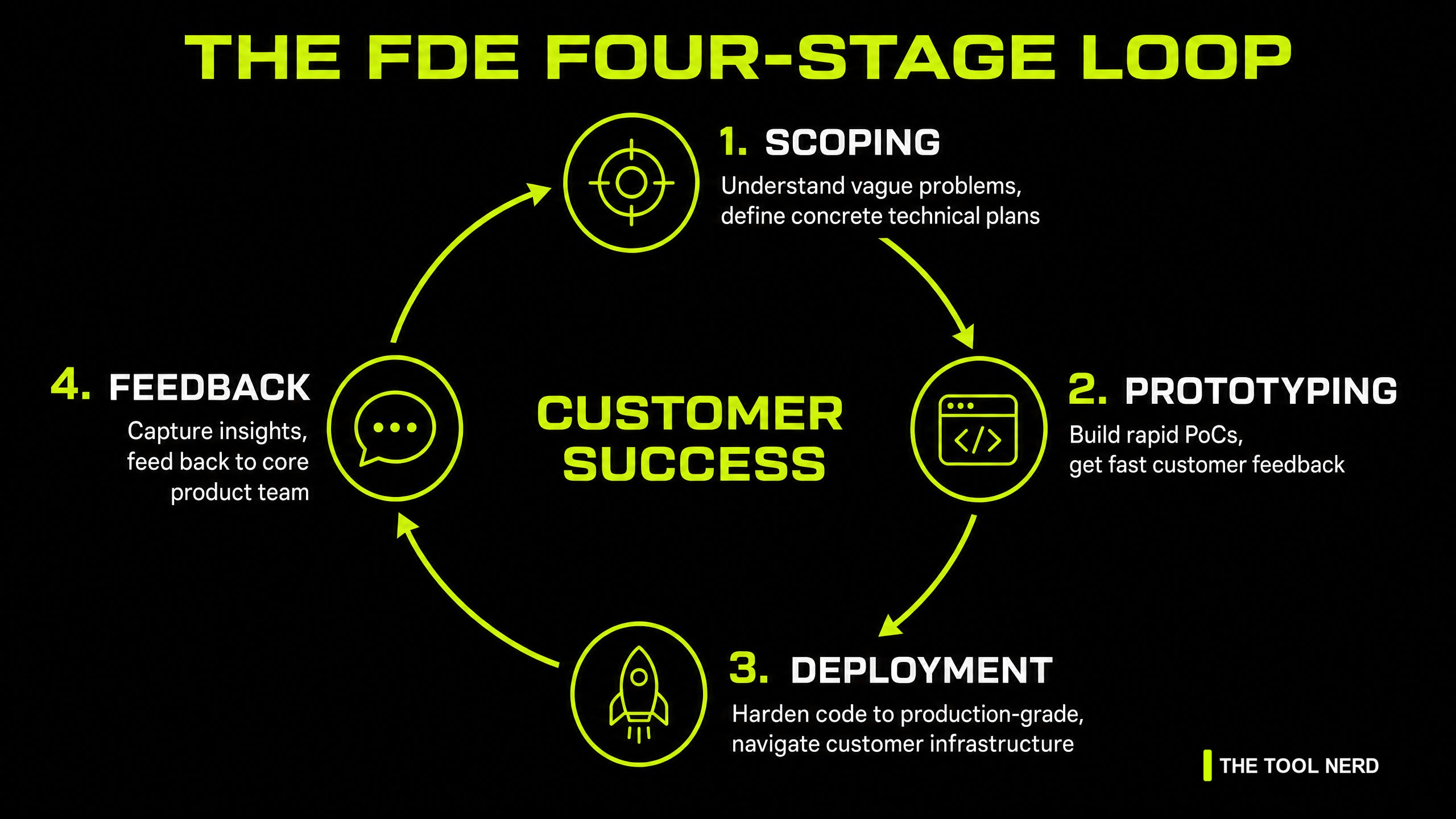
The work of an FDE follows a relentless four-stage loop.
They start with scoping. A customer presents a vague problem— “We want to use AI in our factory.” The FDE digs in, finds the real bottleneck, and defines a concrete technical plan.
Next comes prototyping. They move fast, building a proof-of-concept to show the customer what is possible and gather immediate feedback.
Then comes deployment. They harden the code, make it scalable and secure, and navigate the client’s infrastructure to get it live.
Finally, feedback. They take the insights they’ve gathered on the front lines and bring them back to the core product team, ensuring the platform evolves based on real-world friction.
It is a high-stress, high-impact role. You might spend 25-50% of your time travelling, working in unconventional environments from factory floors to airgapped defence installations. The ownership mentality required is absolute.
Forward Deployed Engineer Salary: Authentic Data from Job Portals and Reports
Glassdoor Data (609 Submissions, June 2026)
According to Glassdoor’s aggregated salary data, the FDE market shows significant variation by experience level and company [6]:
Average total compensation: $155,711 per year
Typical range: $124,407 (25th percentile) to $197,984 (75th percentile)
Top earners (90th percentile): $243,785 per year
Top paying industry: Information Technology at $134,925 median
Top paying companies: Palantir Technologies, C3 AI, ActionIQ
Recruiting from Scratch Analysis (135 Active Job Postings, May 2026)
Recruiting from Scratch analyzed 135 real FDE job postings and found [7]:
Median base salary: $190,000
Range: $160,000 (25th percentile) to $220,000 (75th percentile)
Geographic premium: San Francisco median of $192,000 is 7% higher than remote median of $180,000
Experience-based breakdown:
Entry-level (3-5 years): ~$160,000
Senior (5-8 years): ~$190,000
Staff/Principal (8+ years): $220,000+
Perspective AI Report: The Definitive 2026 FDE Compensation Study
Perspective AI synthesized 1,200 FDE compensation data points from Levels.fyi, public job postings, and pay-transparency disclosures, revealing a bifurcated market [8]:
Frontier Labs (OpenAI, Anthropic):
Mid-level: $385K total compensation
Staff-level: $610K total compensation
Principal: $1.0M+ total compensation
Equity: 60-70% of total comp (up from 35-45% in 2024)
Equity structure: RSUs on private stock, 4-year vest, 1-year cliff, liquidity via annual secondary tender offers
Applied-AI Startups (Series B-D):
30-40% less than frontier labs in total comp
Higher early-stage equity upside potential
4-year vest, 1-year cliff
Palantir FDSE (Public Company):
Median total compensation: $215K
Base salary: $135,000-$200,000
Equity: RSUs on public PLTR stock (immediately liquid on vest)
Bonus: 15-25% of base, often tied to delivery and customer-expansion metrics
Fortune 500 / Big Banks:
Base: $190,000-$420,000
Equity: 15-25% of total compensation
Low-multiplier upside compared to frontier labs
Key Finding: Equity now represents 55-70% of compensation at frontier labs, up significantly from 35-45% in 2024. The entire comp gap between Palantir ($215K median) and frontier labs ($385K+ mid-level) sits in equity [8].
Forward Deployed Engineer Job Openings at Major Companies (May 2026)
OpenAI
OpenAI has the most aggressive FDE hiring in the industry, with roles across multiple continents and specializations:
Forward Deployed Engineer - NYC
Forward Deployed Engineer - Dublin
Forward Deployed Engineer - Gov (San Francisco)
Forward Deployed Engineer - GPS (Sacramento, CA)
Platform Engineer, Forward Deployed Engineering (FDE) - SF
Design Verification, Forward Deployed Engineering (multiple locations)
Estimated open roles: 15-20+ positions across multiple geographic hubs
Anthropic
Anthropic’s Applied AI team is growing aggressively to compete with OpenAI:
Applied AI Engineer (London, UK)
Applied AI Engineer, Beneficial Deployments
Multiple Applied AI roles across regions
Estimated open roles: 10-15+ positions
Strategic context: Anthropic’s Applied AI team is scaling to support enterprise deployments of Claude
Palantir Technologies
As the FDE pioneer, Palantir maintains the largest dedicated FDE hiring pipeline:
Forward Deployed Software Engineer (multiple locations)
Forward Deployed Infrastructure Engineer - UK Government (London)
Forward Deployed Software Engineer - various regions
Estimated open roles: 20-30+ positions
Salary range: $135,000-$200,000 base (from published job postings)
Scale AI
Scale AI is building out its Applied AI engineering team to support enterprise customers:
Applied AI Engineer roles
Customer-focused deployment positions
Microsoft, Google, Meta
These companies are building AI deployment capabilities but have not yet formalized “FDE” as a distinct role title. Meta recently announced plans to launch an Enterprise Solutions unit with embedded engineers (May 2026), signaling that the FDE model is becoming table stakes across the industry [3].
The Trillion-Dollar Opportunity: Automating the FDE Function
The FDE role is currently the bridge from the technical market to the non-technical market. But the long-term play is automation.
Every major coding agent and LLM company will eventually attempt to productize their FDE teams. We are already seeing the beginnings of this. Voice agents are running discovery interviews to map workflows. Cloud agents are building prototypes. Sub-agents are prioritizing AI use cases based on business impact versus engineering effort.
Context extraction and creation is the next most valuable problem to solve. If you can figure out how to extract and create context at scale, the financial upside is massive. The coding agents can handle the rest.
Until that automation is perfected, the Forward Deployed Engineer remains the most critical, and highest-paid, human in the enterprise AI deployment loop.
If you would like to read interesting articles like these check out my previous articles


References
[1] Mike Fishbein on X. “After 40+ forward deployed engineering (FDE) engagements...”
[2] FDE Academy. “How Palantir Invented the Forward Deployed Engineer Model” https://fde.academy/blog/how-palantir-invented-the-forward-deployed-engineer-model
[3] Forbes. “AI Giants Bet Billions On The Most Expensive Job In Enterprise” https://www.forbes.com/sites/janakirammsv/2026/05/28/ai-giants-bet-billions-on-the-most-expensive-job-in-enterprise/
[4] Hashnode. “The complete 2026 guide to the forward deployed engineer” https://hashnode.com/blog/a-complete-2026-guide-to-the-forward-deployed-engineer
[5] OpenAI. “OpenAI launches the OpenAI Deployment Company to help businesses build around intelligence” https://openai.com/index/openai-launches-the-deployment-company/
[6] Glassdoor. “Forward Deployed Engineer Salaries” https://www.glassdoor.com/Salaries/forward-deployed-engineer-salary-SRCH_KO0,25.htm
[7] Recruiting from Scratch. “Forward Deployed Engineer Salary in 2026: Real Data from 200K Job Postings” https://www.recruitingfromscratch.com/blog/forward-deployed-engineer-salary-in-2026-real-data-from-200k-job-postings
[8] Perspective AI. “The 2026 Forward Deployed Engineering Compensation Report: What 1,200 FDEs Earn” https://getperspective.ai/blog/2026-forward-deployed-engineering-compensation-report-1200-fdes