

When I first set up OpenClaw a few months ago, I built a 7-agent “Mission Control” system to run TheToolNerd. I had agents researching tools, monitoring social media, and preparing my daily briefings. It felt like the future. But the reality of running it daily was different.
Updates broke my configurations. The agent’s memory got bloated so quickly that I burned through my OpenAI credits. And worst of all, the agents would forget what I taught them. I’d ask them to do the same task twice and they’d make different mistakes both times.
I needed an assistant, not a second job.
I had been hearing about Hermes Agent for a while.
The promise was compelling: an agent that actually learns from experience, creates its own guides, and doesn’t forget them the next day.
A couple of weeks ago, I finally made the switch. Here is my honest assessment of Hermes Agent, how it compares to OpenClaw, and why it is now running my operations.
Do check out my previous articles


What is Hermes Agent? (And Why It’s a Different Kind of AI Agent)
Hermes Agent is an open-source tool built by Nous Research, a lab that builds AI models. Unlike other agent tools that just wrap existing APIs, Hermes is designed from the ground up to learn and improve over time.
Unlike OpenClaw, which focuses on orchestrating teams of specialized agents, Hermes is a single agent that runs a persistent learning loop. It does not just log what happened; it extracts what worked, writes it as a reusable guide, and loads it the next time you need it.
It lives wherever you put it. You can run it locally or drop it on a $5 VPS. You communicate with it through Telegram, Discord, Slack, or your terminal, while it works quietly in the background.
Why I Switched: The OpenClaw Reality Check
My previous experience with OpenClaw taught me a lot about what I actually needed from an agent framework. OpenClaw is powerful for building complex, multi-agent systems. If you need a Slack agent, an email agent, and a research agent all talking to each other, OpenClaw is the right tool.
But for my workflow, the architecture created more problems than it solved.
The Reliability Problem.
Even after carefully defining instructions and guides, OpenClaw failed often. I would ask it to run my tool approval workflow, and it would make up steps or get stuck. I had to constantly redo the work or reteach it the process.
The Context Bloat & Memory Problem
OpenClaw’s memory system is rich but gets bloated. It drags old, irrelevant conversations into new tasks. Even after reteaching it a guide and explicitly asking it to update its memory, it would somehow lose track and fail to execute the work as expected.
The Skyrocketing Cost Problem
Frontier models (like GPT-5.5, Claude) consume massive amounts of tokens when running multi-agent systems. The token usage was unsustainable. I had to switch to open-source and open-weight models via OpenCode Go (referral link), which gave me access to models like MiniMax 3 and GLM 5.1 at a fraction of the cost.
The Hermes Advantage: A Self-Improving AI Agent That Actually Learns
Hermes approaches these problems differently. It is not trying to be a whole organization of agents. It is trying to be one extremely competent operator that gets better at your specific workflows over time.
Autonomous Guide Creation from Real Experience
The most significant difference is how Hermes handles guides. In OpenClaw, guides are static. You write them, deploy them, and hope they work.
Hermes creates guides autonomously. When it completes a complex task—such as recovering from an error or executing a tricky workflow—it automatically records what it did. The next time you ask for something similar, it uses that written guide instead of figuring it out from scratch. It even improves these guides as it uses them.
Lean, Search-First Memory That Eliminates Context Bloat
Hermes keeps its memory lean and fast. Instead of dragging everything into every conversation, it separates:
Core Instructions (things it needs to know every time)
Past Conversations (which it searches only when relevant)
Guides (which it loads only when needed)
This prevents the bloat that slowed down OpenClaw. An agent with 200 guides pays roughly the same memory cost as one with 40, because detailed guide content only enters the conversation when actually needed.
Hands-On Testing: Automating the ToolNerd Approval Workflow
The real test was my ToolNerd approval workflow. This is a complex, multi-step process that OpenClaw struggled with consistently.
The workflow requires the agent to:
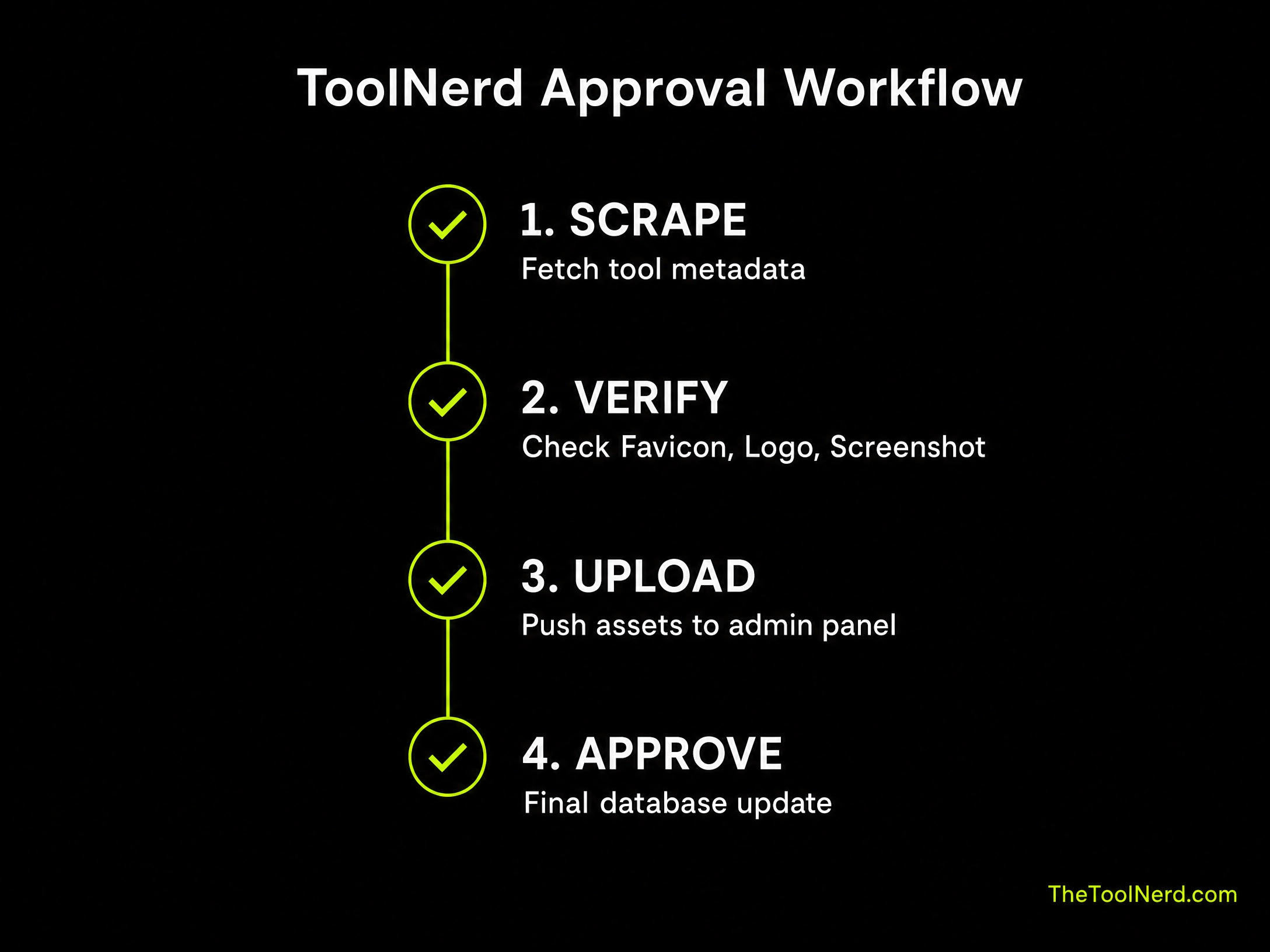
Query my Supabase database for unapproved tools
Check if the screenshot, logo, and favicon are valid
If assets are missing or broken:
Navigate to the official website
Download the icon
Upload it to Supabase storage
Take a screenshot
Update the database record
OpenClaw hallucinated steps and made errors most of the time on this workflow.
I exported my guides from OpenClaw as a zip file and fed them directly to Hermes. Hermes imported them seamlessly. When I ran the workflow, it executed smoothly on the first try. I monitored it every day for a week, and it consistently performed the task without intervention. The only hiccup occurred when my API credits ran out, requiring a simple retry command.
That consistency is the thing. OpenClaw would work once, then fail the next day. Hermes just kept running.
Setup and Deployment: Why Hermes is Surprisingly Simple
OpenClaw has a notoriously fragile setup process. Every update seems to break a configuration file or wipe out environment variables.
Hermes is significantly easier to deploy. I set it up on Railway in minutes.
Setting up a single communication channel via Telegram was straightforward. I did face some initial challenges setting up multiple profiles and bots for my more experimental workflows. But once configured, the ability to have multiple profiles—essentially an army of agents sharing the same environment, guides, and memory—proved incredibly powerful. I now have dedicated agents managing different Telegram topics without any cross-contamination.
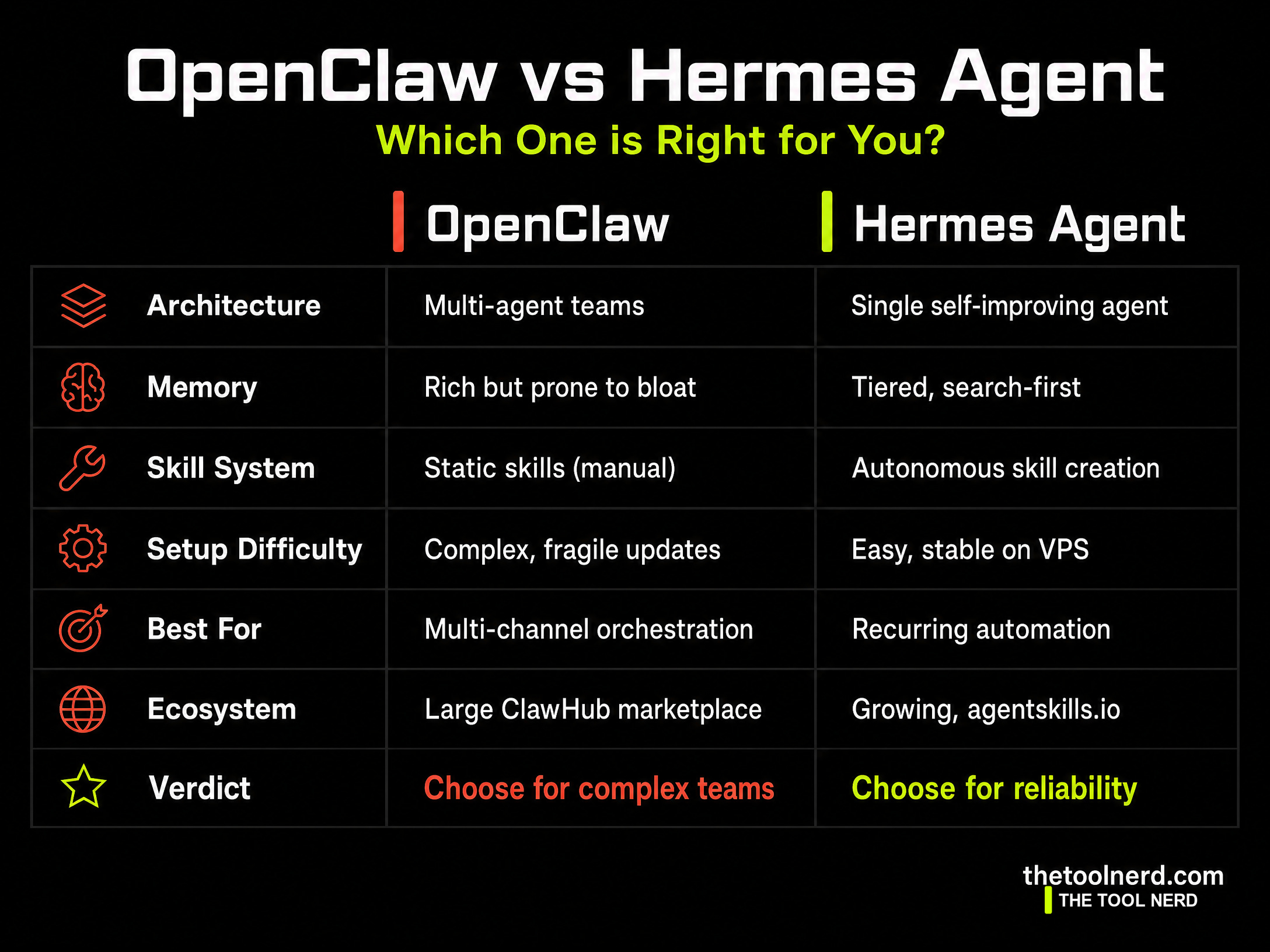
Head-to-Head Comparison: Hermes Agent vs OpenClaw
Pros & Cons: My Honest Assessment of Both Frameworks
Where Hermes Agent Excels
Hermes autonomously learns and improves workflows from experience, which is the single biggest differentiator from every other agent framework I have tested. It keeps memory lean and fast, preventing the bloat that slowed down OpenClaw. It runs smoothly on low-cost VPS infrastructure without the constant maintenance burden. And the real-time emoji-mapped tool usage in Telegram makes it transparent—you always know what it is doing and can interrupt it mid-task.
Where Hermes Agent Still Falls Short
The multi-agent architecture uses a parent-subagent model rather than persistent communicating teams, which makes it weaker for complex coordination scenarios. Configuring multiple profiles and bots takes trial and error. The guide marketplace is smaller compared to OpenClaw’s ClawHub, though the agentskills.io open standard means guides are portable across compatible agents.
The Final Verdict: Which AI Agent Framework Should You Choose?
Both frameworks have their place in the evolving AI agent ecosystem. The choice comes down to your actual workflow.
Choose OpenClaw if you are building a complex, multi-channel control plane. If you need dedicated agents monitoring Slack, Discord, and email simultaneously, and you need those agents to collaborate with persistent state, OpenClaw’s architecture is built for that. It also has a larger marketplace of pre-built guides.
Choose Hermes Agent if you want a personal runtime that handles recurring automation and improves over time. If your workflows involve daily reports, research loops, data collection, or complex repetitive tasks like my tool approval process, Hermes is the clear winner.
Hermes feels leaner, more transparent, and significantly more reliable for the work I do. The fact that it actively learns from my corrections and builds its own procedural memory makes it feel less like a brittle script and more like an actual assistant.
OpenClaw has a ton of features and a vibrant community. Hermes is catching up and is a strong contender. As a legitimate company with a dedicated team building it, I am more confident in Hermes’ trajectory than I am in OpenClaw’s.
Ready to Make the Switch?
If you are dealing with bloated context windows, skyrocketing API costs, and agents that suffer from amnesia, Hermes Agent offers a compelling alternative.
With the recent release of Hermes Desktop, the barrier to entry is lower than ever. You no longer need to be a command-line expert to get an autonomous agent running on your machine.