

“You don’t need to buy software anymore. Just build it yourself.”
If you spend any time on X or LinkedIn, you’ve seen this pitch. The founders of the hottest AI companies are telling us that coding is dead, natural language is the new programming, and anyone can build a custom CRM or support system over the weekend.
It’s a compelling narrative. It’s also completely contradicted by their own actions.
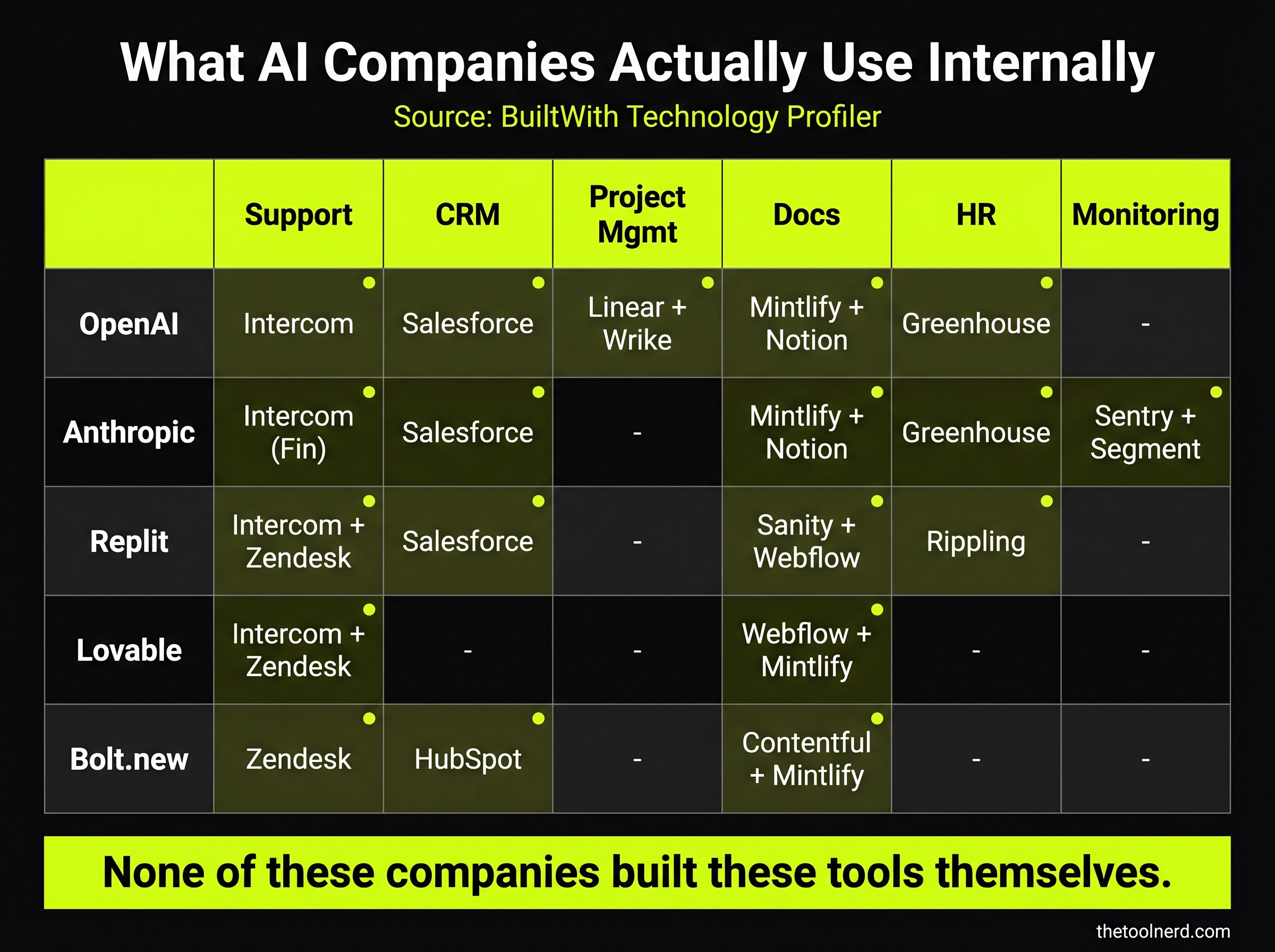
I analyzed the internal tech stacks of the biggest names in AI—OpenAI, Anthropic, Replit, Lovable, and Bolt.new—using BuiltWith data. What I found is a massive gap between what they sell and what they do. These com
panies, armed with the smartest engineers on the planet and the most advanced AI models ever created, are not building their own internal tools.
They are buying them. Just like everyone else.
Here is the data-backed truth about the “build anything” myth, and the pragmatic lessons every founder needs to learn from it.
Check out my previous articles :


The Data: What AI Companies Actually Use
When you look under the hood of these AI juggernauts, you don’t find custom-built, AI-generated internal tools. You find standard SaaS subscriptions.
About the data: BuiltWith is a Sydney-based web intelligence platform founded in 2007 that crawls millions of websites to detect the technologies they run — used by sales teams, analysts, and researchers worldwide as a standard source for tech stack data. It does quarterly crawls across its database, making it a reliable but point-in-time snapshot rather than a live feed.
Let’s break this down by category to see exactly where these companies choose to spend their money instead of their engineering time.
1. Customer Support: The Intercom Dominance
If there’s one area where you’d expect AI companies to build their own solutions, it’s customer support. After all, answering questions is what LLMs do best. Yet, the data shows a complete reliance on established vendors.
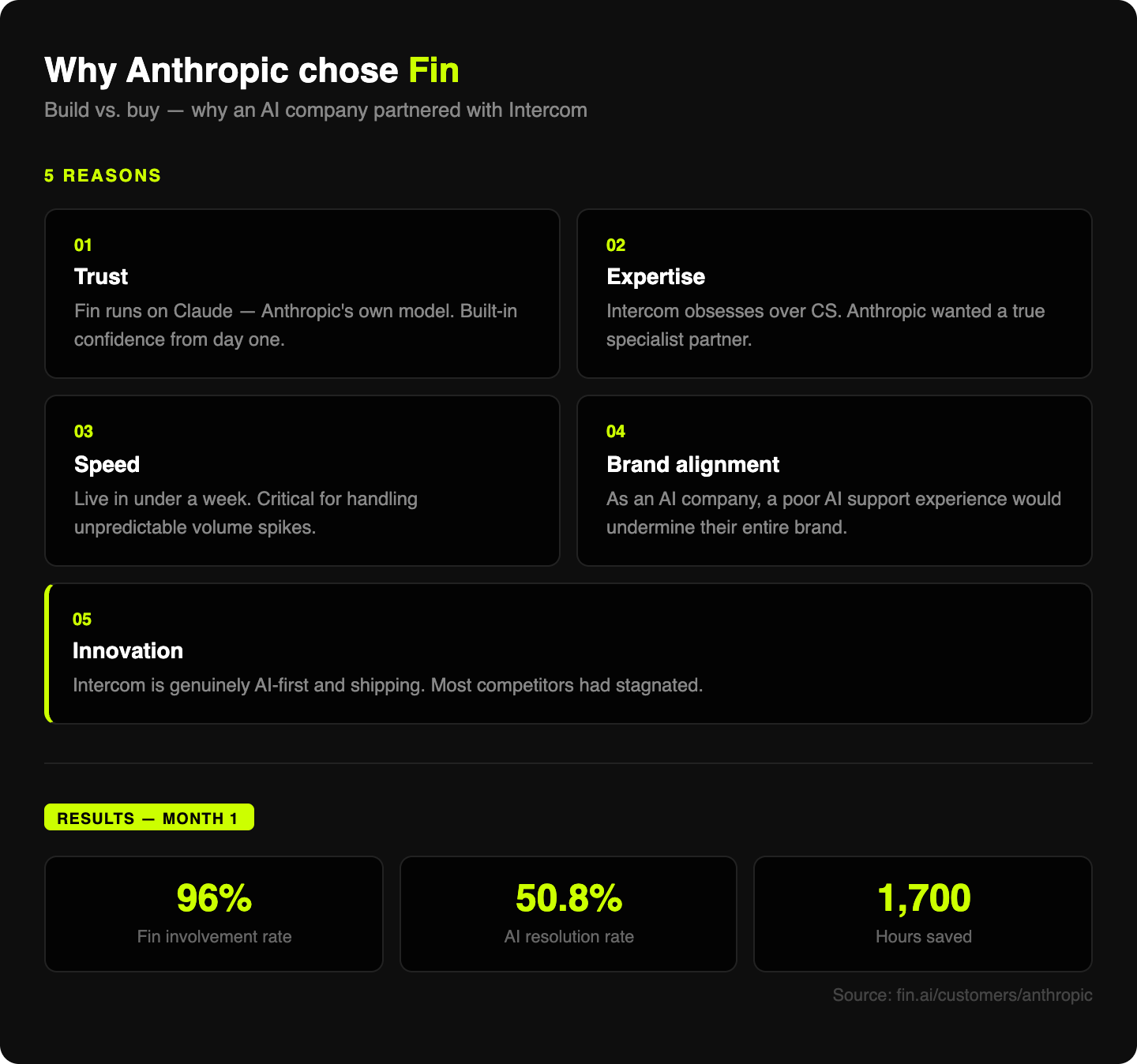
Anthropic didn’t build a custom support bot from scratch. They bought Intercom’s service and implemented FinAI
In a recent case study by FinAI, Emily Lampert, Head of Product Support at Anthropic, noted that Fin automatically resolved tens of thousands of customer queries, achieving a 50.8% resolution rate in just over a month [1].
Why didn’t Anthropic build this themselves? This is what their Product Support Operations said
“If you’re debating whether to build your own AI solution or buy one, as a fast-growing company in a complex space, my advice would be to buy – and specifically, buy Fin.” - Isabel Larrow, Product Support Operations at Anthropic
They chose speed, trust, and Intercom’s deep expertise in customer service workflows over the vanity of building it in-house.
Make a note of this — “Deep Expertise in Customer Service”
Check out the case study
2. Project Management: The Linear Standard
Managing complex engineering projects requires robust tools. You might think companies building the future of software would create their own issue trackers. They don’t.
OpenAI uses Linear. They scaled it from a small trial to over 3,000 users across the organization [2]. Before Linear, cross-team collaboration at OpenAI was chaotic, with different teams using different tools.
Gabriel Peal, an engineer at OpenAI, explained the appeal:
“It’s like a Katamari Ball. You get a couple of people to use it and then it snowballs.”
They chose Linear because it remained fast and performant at scale, reducing the friction of creating and modifying tickets. They bought a tool that set a standard for quality craftsmanship, rather than wasting time building a mediocre internal clone.
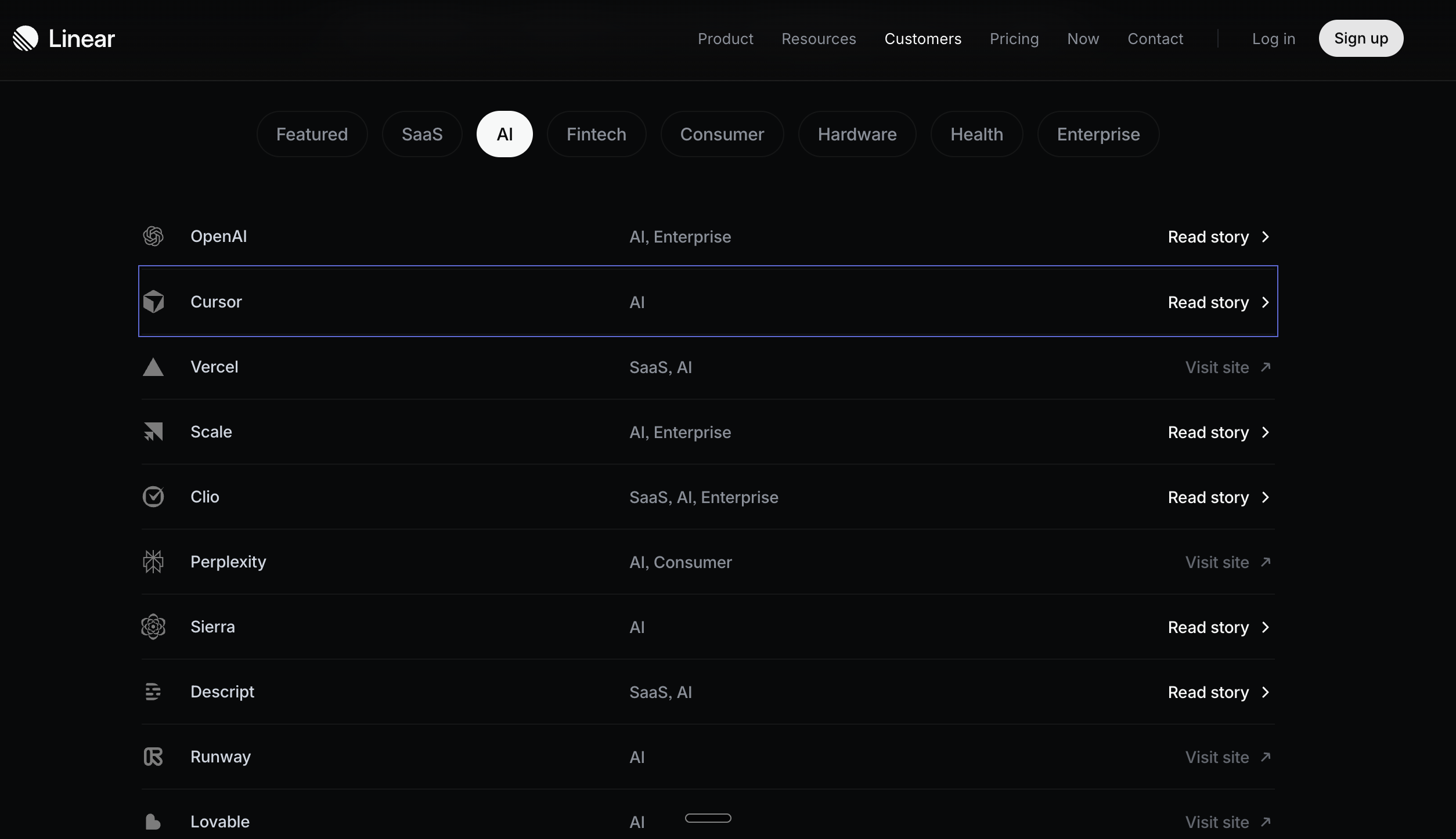
Most of the Top AI companies you know are their customers - Cursor, Vercel, Perplexity, Lovable, Replit etc..
3. Documentation: The Mintlify Takeover
Developer documentation is critical for AI platforms. Surely, companies like Anthropic and OpenAI build their own custom documentation sites?
Wrong again.
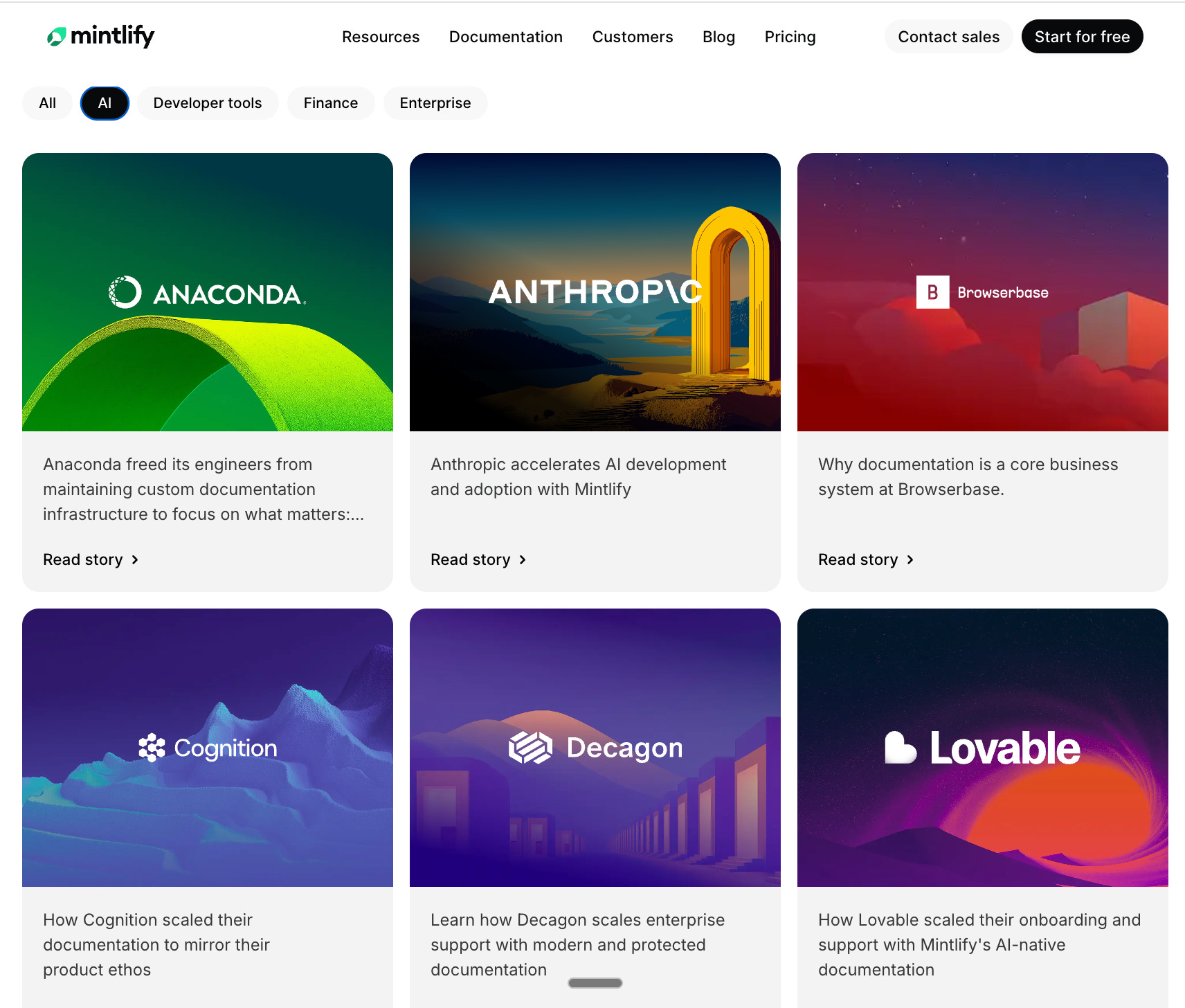
Anthropic uses Mintlify to serve documentation to over 1.5 million developers every month [3]. When launching the Claude Sonnet 3.5 model, they needed a platform that could scale instantly without adding engineering overhead.
“It was really impressive to see how fast we could ship our docs with Mintlify.” - Brian Krausz, Member of Technical Staff at Anthropic
Instead of building infrastructure, Anthropic partnered with Mintlify to co-develop AI-native features like LLMs.txt, improving how their docs are ingested by other AI tools.
4. CRM and HR: The Enterprise Staples
The pattern continues across every major business function.
OpenAI, Anthropic, and Replit all use Salesforce. Bolt.new uses HubSpot. For hiring, they rely on Greenhouse and Rippling.
These are complex, heavily regulated, and feature-dense domains.
Building a CRM is easy. Maintaining a CRM that handles enterprise sales pipelines, integrates with marketing automation, and provides reliable forecasting is a nightmare.
The Pragmatism Behind the Hypocrisy
The irony is thick. The companies selling the dream of “code your own software” are making the exact opposite choice internally. But when you look past the marketing, their decisions make perfect business sense.
Here is why the smartest engineers in the world choose to buy:
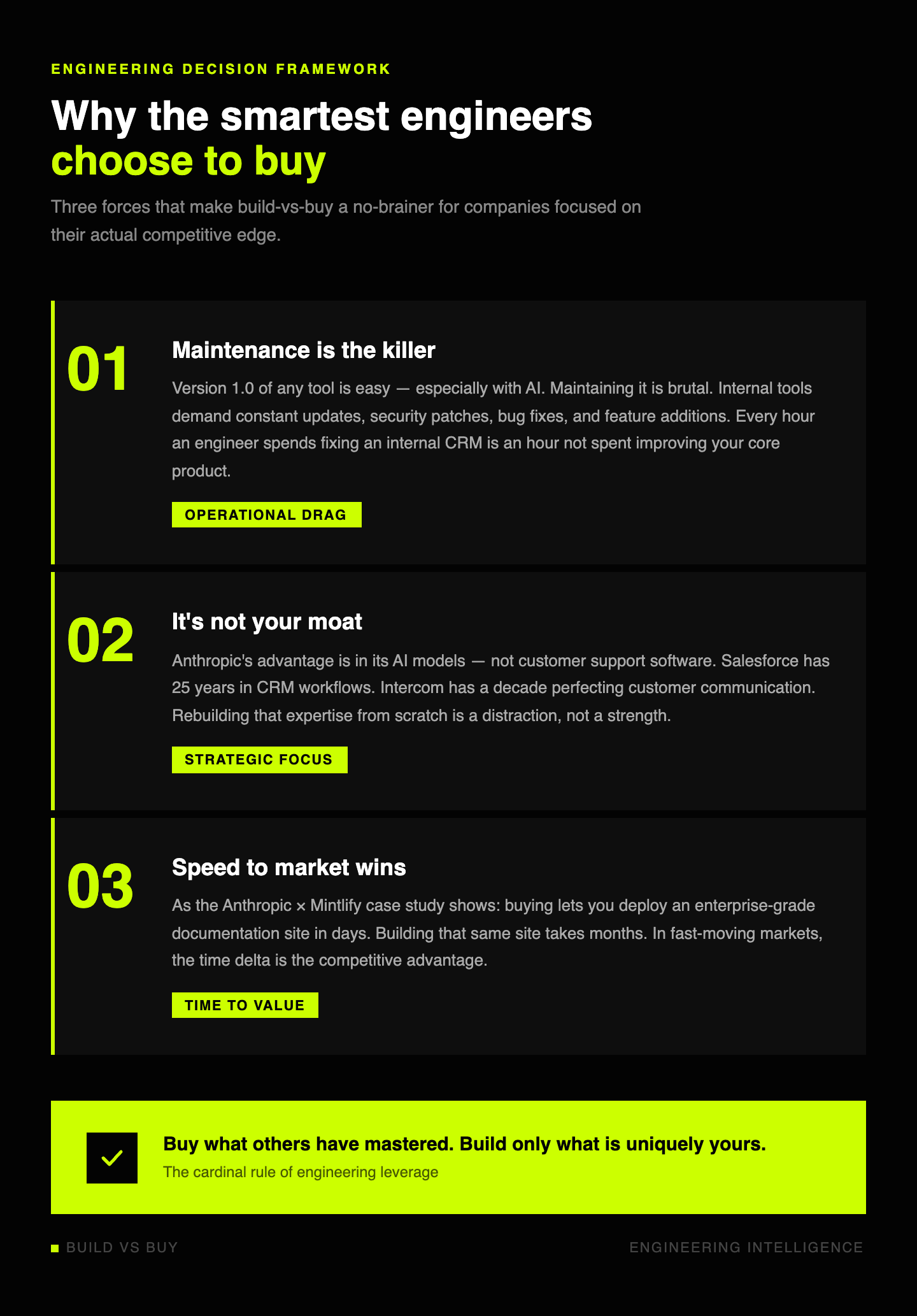
1. Maintenance is the Killer
Building version 1.0 of a tool is easy, especially with AI. Maintaining it is brutal. Internal tools require constant updates, security patches, bug fixes, and feature additions. Every hour an engineer spends fixing an internal CRM is an hour they aren’t spending improving Claude or ChatGPT.
2. It’s Not Their Moat
Anthropic’s competitive advantage is their AI models, not their customer support software. Salesforce has 25 years of expertise in CRM workflows. Intercom has spent a decade perfecting customer communication. Why would an AI company try to rebuild that expertise from scratch?
3. Speed to Market
As the Anthropic/Mintlify case study shows, buying allows companies to move incredibly fast. You can deploy an enterprise-grade documentation site in days. Building it takes months.
The Build vs. Buy Framework for Founders
This data provides a wake-up call for founders and builders. Just because you can build it doesn’t mean you should.
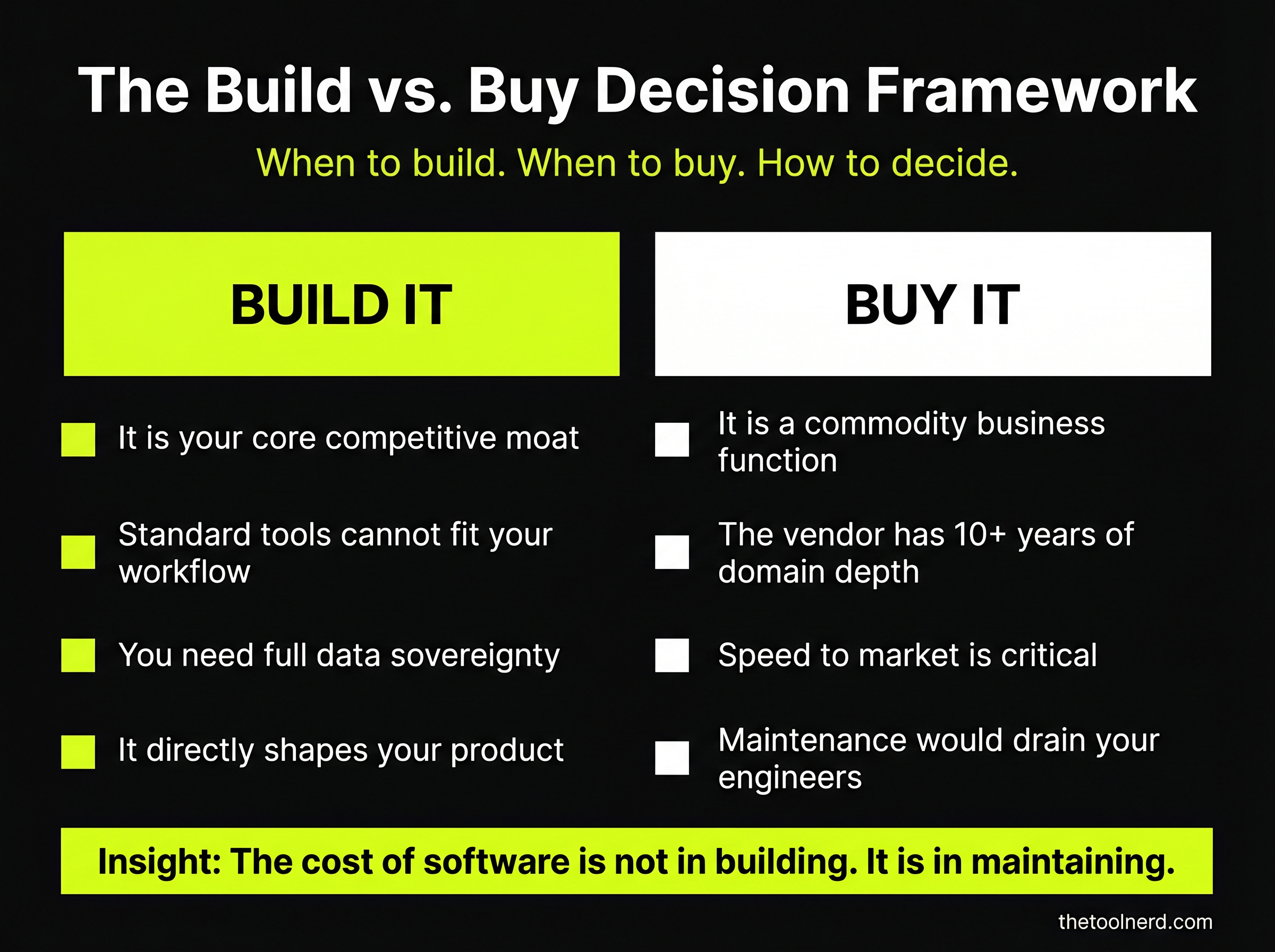
Here is a pragmatic framework for making the Build vs. Buy decision:
When to BUILD:
It is your core differentiator. If the software directly impacts your unique value proposition, build it. (e.g., OpenAI building their own model training infrastructure).
Standard tools cannot handle your specific workflow. Your operations are so unique that modifying a SaaS tool would be harder than building from scratch.
You need absolute control over data security. Regulatory or compliance reasons demand that the data never touches a third-party server.
When to BUY:
It is a commodity function. CRM, HR, customer support, and project management are solved problems. Buy the solution.
The vendor has deeper domain expertise. You cannot out-build Salesforce on CRM features or Intercom on support routing.
You need to move fast. If time-to-market matters, buying is always faster than building.
You want to avoid maintenance debt. Let the vendor worry about uptime, security patches, and feature requests.
The Verdict
The narrative that AI will replace all SaaS companies because “everyone will just build their own software” is a myth. The very companies creating this AI are proving it false every day.
They understand a fundamental truth of software engineering: the cost of software isn’t in the building; it’s in the maintaining.
Use AI to build your core product faster. Use AI to prototype new ideas. But when it comes to running your business, follow the lead of OpenAI and Anthropic. Buy the best tools available, and focus your engineering talent on the problems only you can solve.
References
[1] Intercom. “Anthropic Customer Story.” https://fin.ai/customers/anthropic
[2] Linear. “OpenAI Customer Story.” https://linear.app/customers/openai
[3] Mintlify. “Anthropic Customer Story.” https://www.mintlify.com/customers/anthropic