

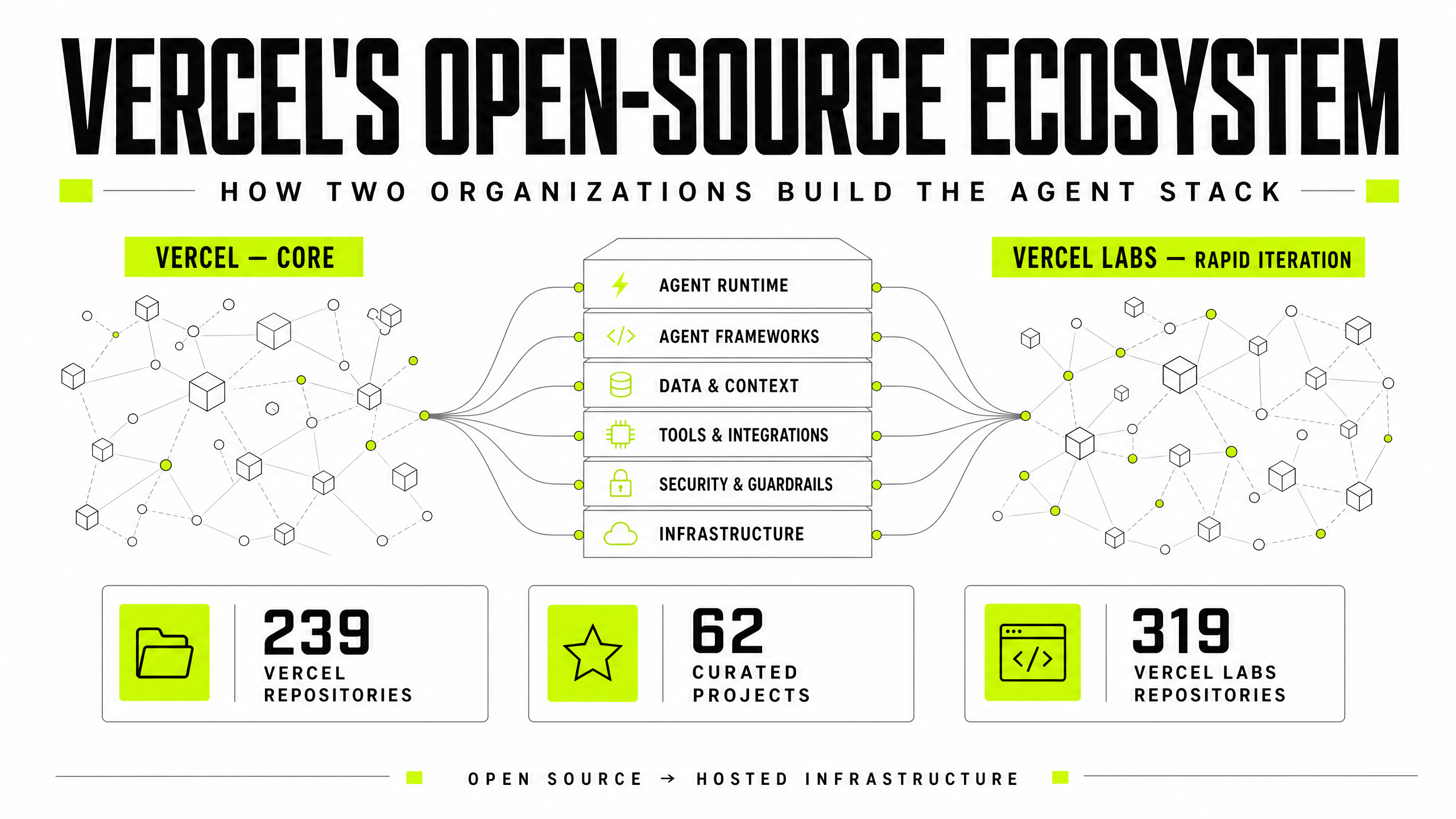
Vercel is shipping production-grade AI infrastructure at a pace most companies reserve for their core products—and doing it in public. Across two GitHubs, 558 repositories the company is building an entire stack for AI agents while keeping the frameworks millions of developers rely on stable and boring.
This isn’t a story about counting repos. It’s about how Vercel turns free open-source tools into demand for its paid infrastructure, and how splitting its work across two organizations lets it move fast on agents without breaking Next.js.
If you would like to check out my previous articles, please check out here.


The Vercel Flywheel: Open-Source as Distribution
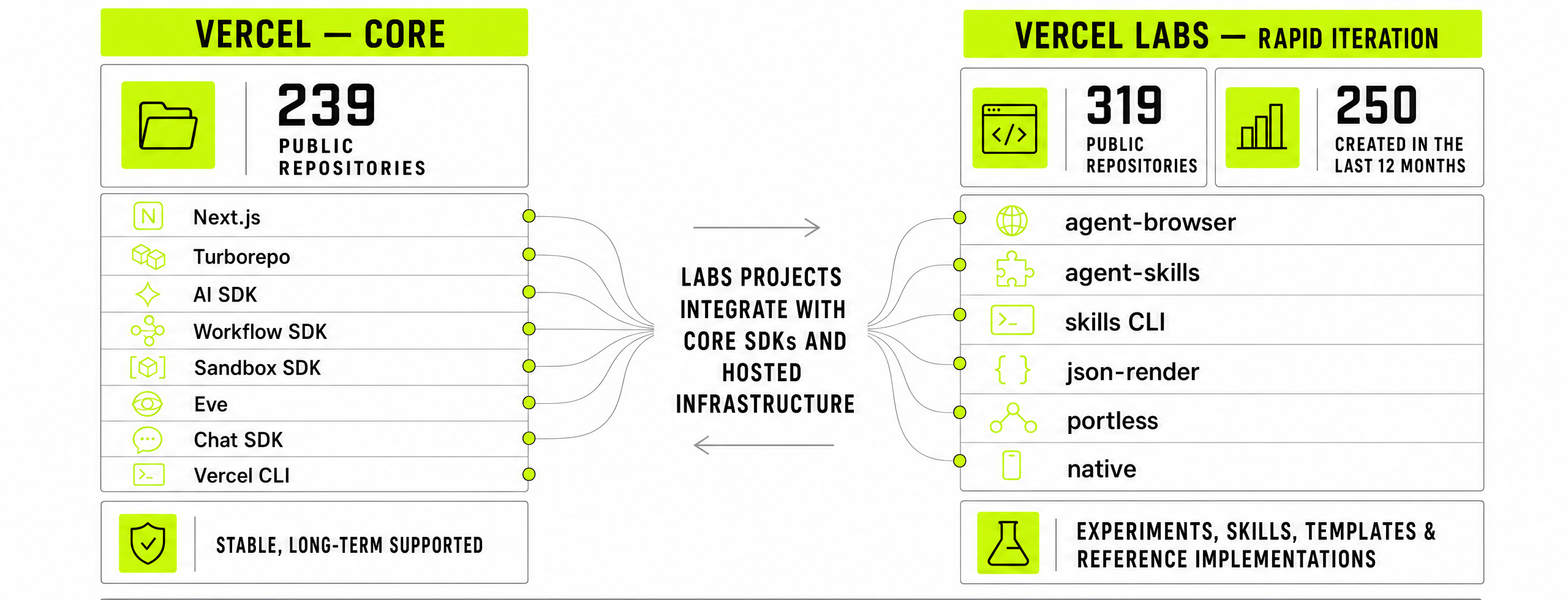
Vercel’s business model is not “sell open-source.” It’s “build open-source to drive adoption of hosted services.” This distinction matters.
Consider Next.js. It’s free. It’s open-source. Millions of developers use it without ever paying Vercel a dollar. But those developers are the target. They use Next.js to build their applications. When it comes time to deploy, Vercel’s platform is the natural choice—it’s optimized for Next.js, it’s faster, and it just works. That’s when Vercel makes money.
The same pattern repeats across their entire ecosystem. Open-source projects create awareness and adoption. Hosted services monetize the infrastructure. Premium features and enterprise offerings capture additional value.
Six Layers of Developer Infrastructure
Vercel’s open-source portfolio organizes into six strategic layers, each serving a different part of the developer experience:
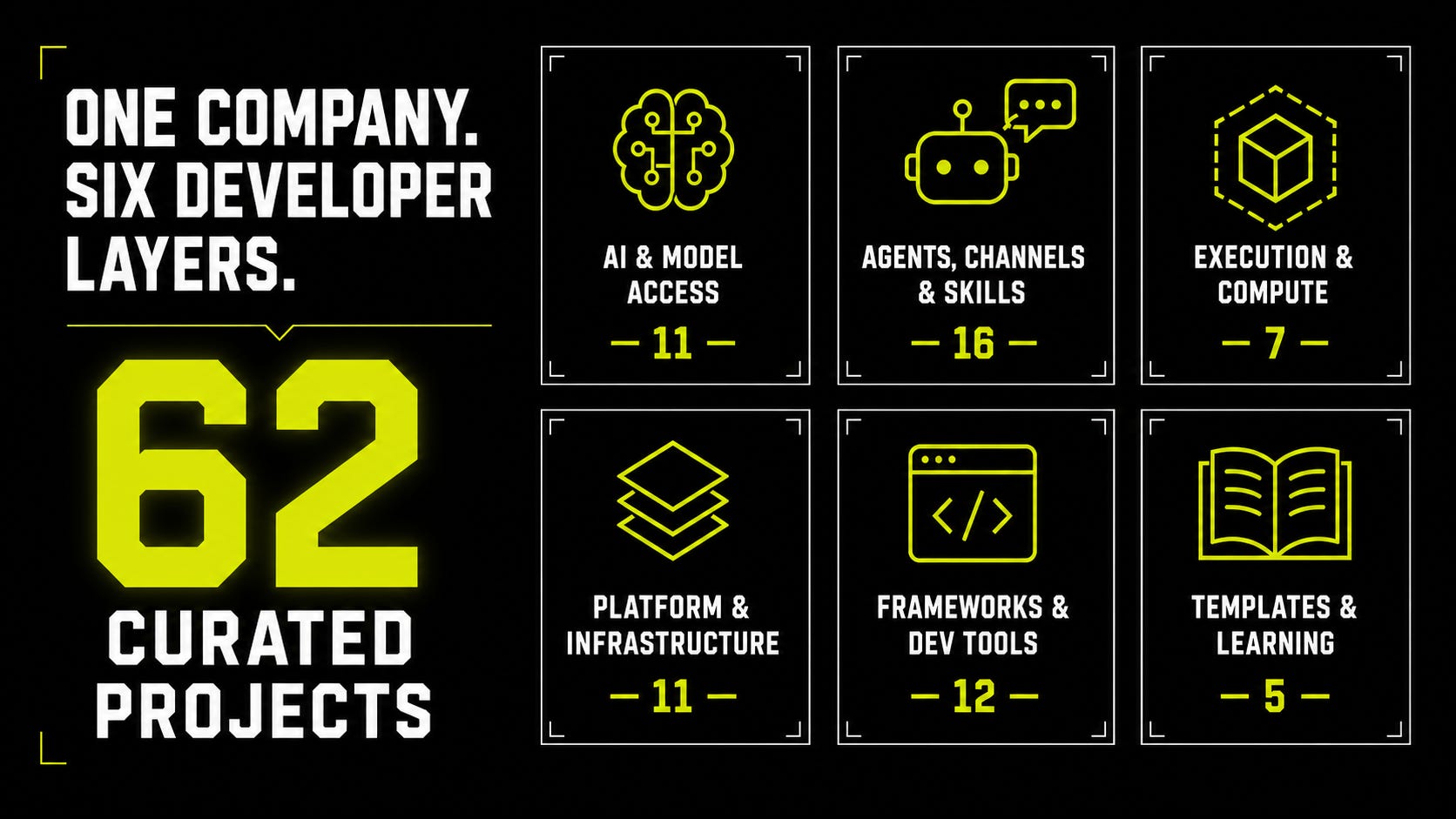
1. AI & Model Access (11 Projects)
The AI SDK is the foundation. With 25,558 GitHub stars and 15.8 million weekly npm downloads, it’s the most downloaded package in Vercel’s entire ecosystem. And it’s not a Vercel-only tool—it works with any LLM provider (OpenAI, Anthropic, Cohere, local models) and any framework.
The supporting projects in this layer tell the story. Streamdown renders streaming Markdown for AI output. AI Elements provides pre-built UI components for AI applications. Chatbot is a reference implementation. Together, they form a complete toolkit for building AI applications.
Key projects:
AI SDK — 25,558 stars, 15.8M weekly downloads
Streamdown — 5,397 stars, 24.3% npm growth
AI Elements — 2,219 stars, -17.7% npm growth
Eve — 3,511 stars, 206.8% npm growth (launched June 2026)
2. Agents, Channels & Skills (16 Projects)
This is where Vercel’s emerging strategy becomes visible. Eve is the opinionated production agent framework. Chat SDK unifies communication channels (Slack, Teams, Discord, Telegram). The Skills CLI and agent-skills repository form an ecosystem for reusable agent capabilities.
Agent Browser, launched in January 2026, already has 38,453 stars. Skills has seen 488% npm growth in the last four weeks.
Key projects:
Agent Browser — 38,453 stars, 7.9% npm growth
Skills — 26,145 stars, 488.2% npm growth
Eve — 3,511 stars, 206.8% npm growth
Chat SDK — 2,195 stars, 57.9% npm growth
Agent Skills — 29,067 stars
3. Execution & Compute (7 Projects)
Vercel Workflow SDK enables long-running TypeScript jobs and agent loops. Vercel Sandbox provides ephemeral isolated compute. These are the execution primitives that power Vercel’s hosted Workflow and Sandbox services.
The open-source SDKs let developers build and test locally. The hosted services handle the infrastructure, scaling, and reliability. Vercel charges per execution minute and per compute resource.
Key projects:
Workflow SDK — 2,205 stars, 515,627 weekly downloads
Sandbox SDK — 2,814,701 weekly downloads, 23% npm growth
Tersa — 1,020 stars (AI workflow canvas)
Emulate — 1,515 stars (local API emulation)
4. Platform & Infrastructure (11 Projects)
Vercel SDK is a type-safe REST API client for the entire Vercel platform—deployments, domains, DNS, registrar, remote cache, observability. It’s not just a domain SDK; it’s the distribution surface for all platform features.
Storage clients (Blob, Edge Config), Analytics client, Flags SDK, Edge Runtime—these are all open-source. Vercel monetizes through subscriptions (hosting, domains, storage), usage-based pricing (storage, bandwidth, cache hits), and transactions (registrar purchases).
Key projects:
Vercel CLI — 15,917 stars, 2.7M weekly downloads
Vercel SDK — 275,812 weekly downloads, 6.9% npm growth
Flags SDK — 730,711 weekly downloads
Analytics Client — 3.5M weekly downloads
Edge Runtime — 2.4M weekly downloads
5. Frameworks & Developer Tooling (12 Projects)
Next.js is the flagship. One hundred forty-one thousand stars. Forty-two million weekly downloads. Turborepo is the build system for monorepos. SWR is the data-fetching standard. Satori generates dynamic images. Styled-JSX scopes CSS. Together, they form the developer experience layer that drives adoption of Vercel hosting.
Vercel monetizes through platform features (remote cache, advanced analytics, edge functions) and hosting. The open-source projects are so good that developers use them regardless of where they deploy. But Vercel’s platform is optimized for them, so most developers end up on Vercel anyway.
Key projects:
Next.js — 141,107 stars, 42.1M weekly downloads
Turborepo — 30,716 stars, 17.0M weekly downloads
SWR — 32,431 stars, 12.6M weekly downloads
Satori — 13,647 stars, 1.8M weekly downloads
Styled-JSX — 32.2M weekly downloads
6. Templates & Learning (5 Projects)
Next.js Commerce is a reference implementation for e-commerce. Platforms Starter Kit is a template for multi-tenant SaaS. These templates drive adoption of Vercel hosting and are monetized through the Vercel Marketplace and template gallery.
Key projects:
Next.js Commerce — 10,000+ stars
Platforms Starter Kit — 8,000+ stars
Next Learn — Learning resources
How Vercel makes money
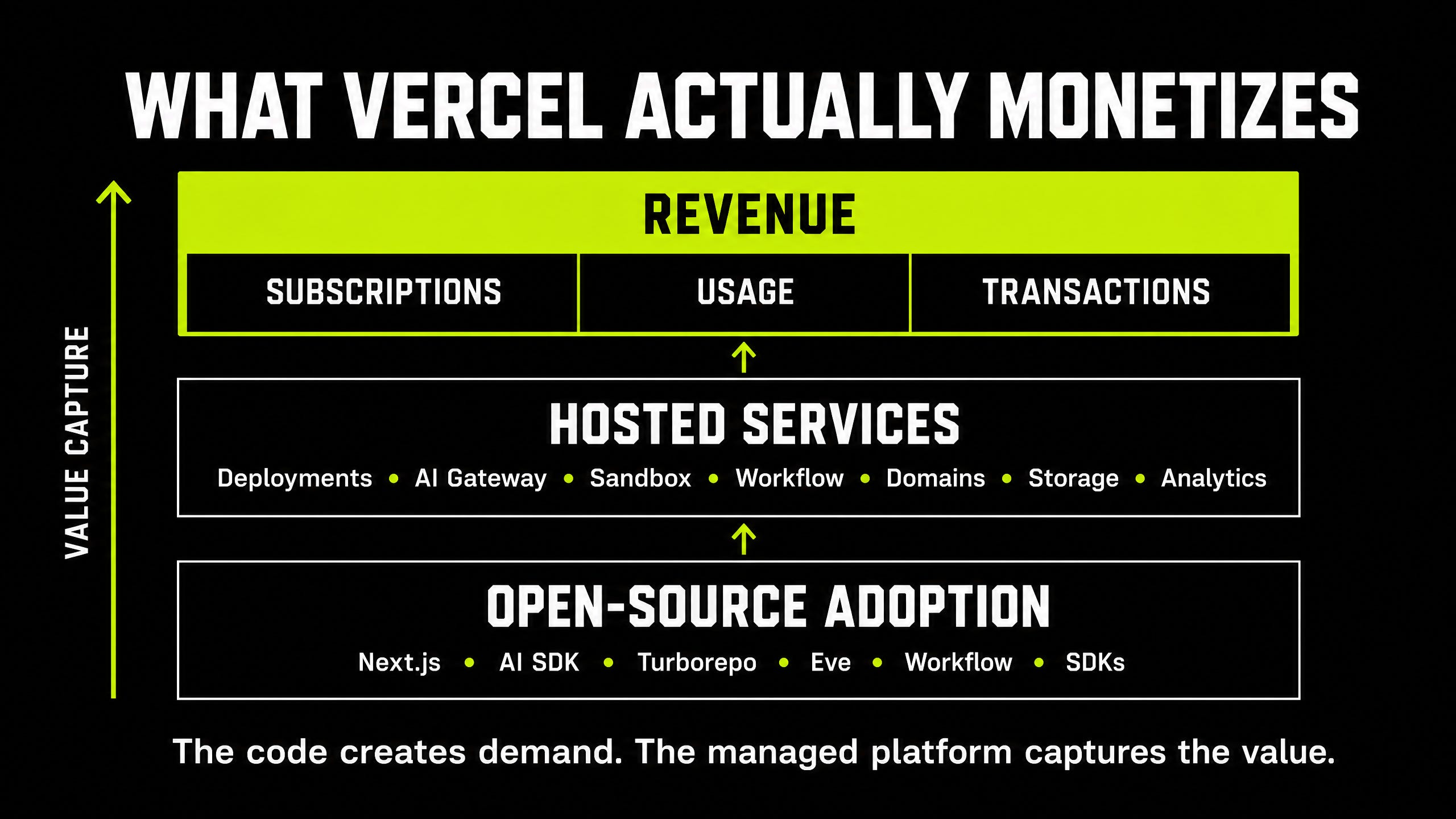
Every layer follows the same four-step arc: adopt the free SDK locally, build something real, run it in production on Vercel, and Vercel monetizes the compute, deployments, token routing, and storage underneath.
It works because the open-source projects are genuinely useful on their own. You can use the AI SDK without Vercel, run Eve without deploying to Vercel, ship Chat SDK without Vercel Connect. But once you’ve built something real, Vercel’s infrastructure is the path of least resistance to running it.
The Vercel Agent Stack: Where New Revenue Grows
The agent stack is where Vercel’s emerging strategy becomes most visible. It’s also where the momentum is highest.
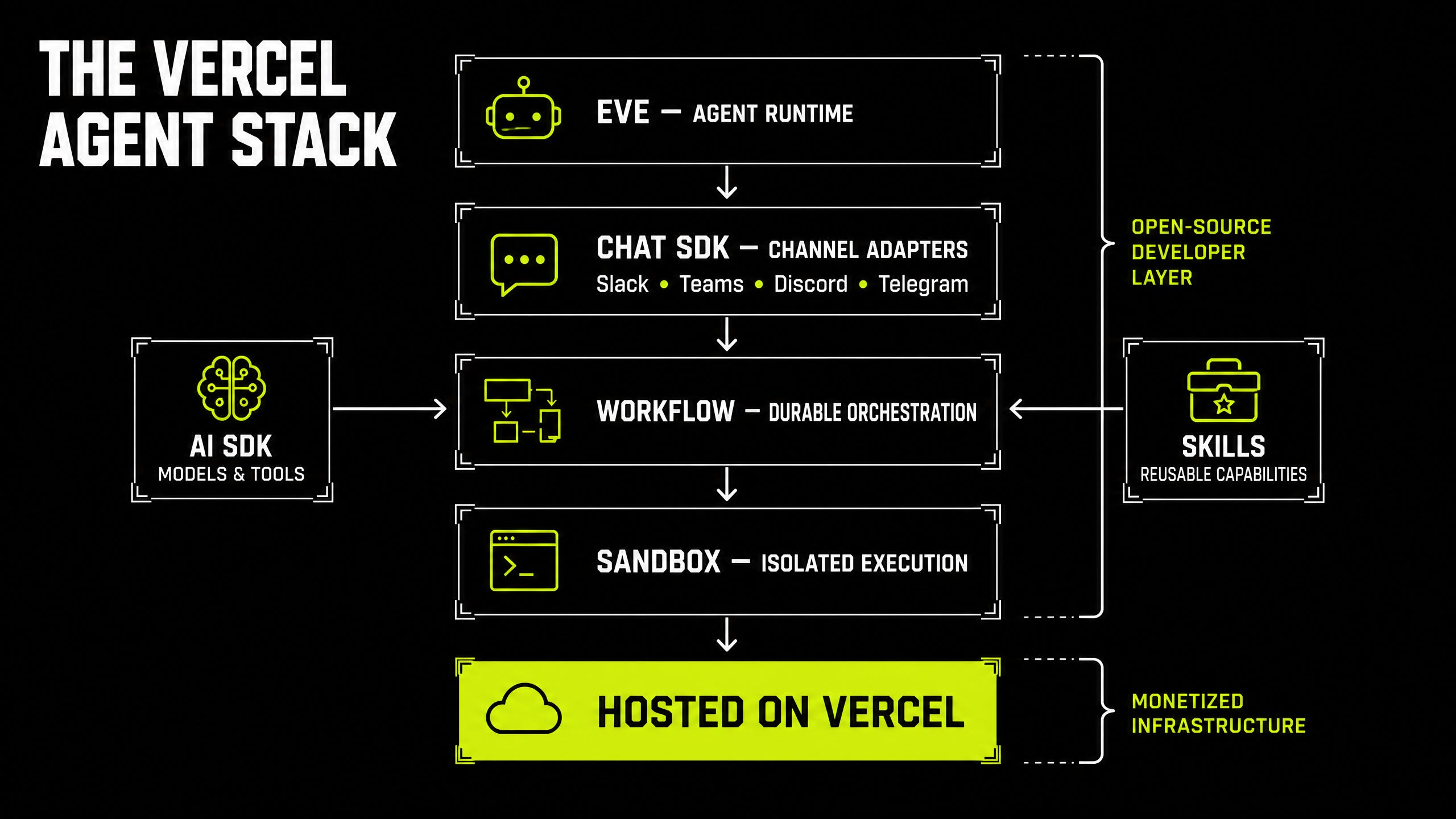
Eve is the runtime. Chat SDK provides channel adapters. Workflow handles durable orchestration. Sandbox provides isolated execution. AI SDK feeds models and tools. Skills provide reusable capabilities. Together, they form a complete system for building production agents.
Vercel is providing the open-source tools to build them locally, then offering the hosted infrastructure to run them at scale.
If you are developer - which Vercel Projects Should You Use?
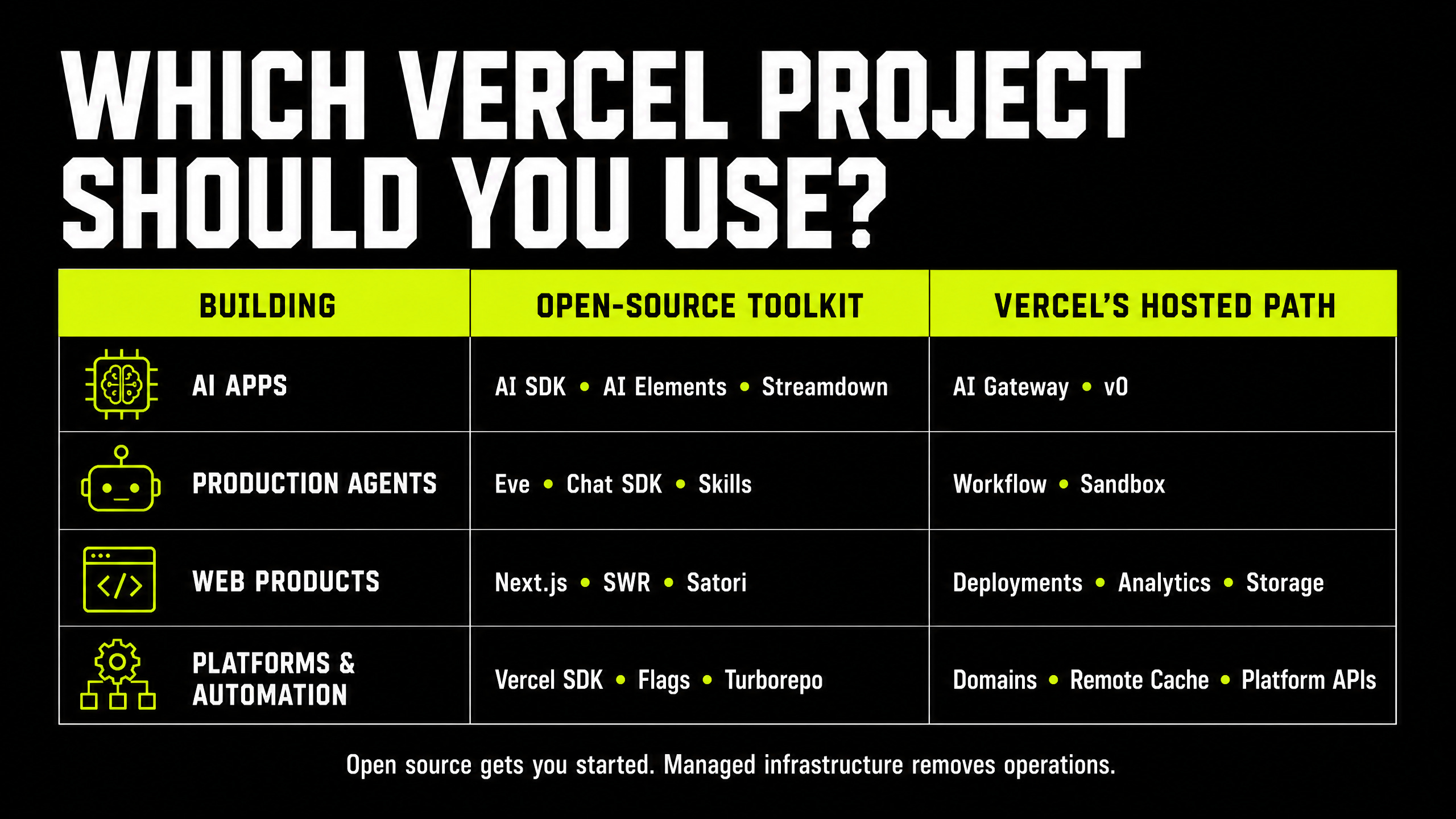
Vercel’s real trick is that none of its open-source tools need Vercel to be useful. You can run Next.js, the AI SDK, or Eve anywhere. But once you’ve built something real, Vercel’s infrastructure is just the easiest place to run it — and that’s where the money is.
The agent stack is the part to watch: it’s the newest bet, it’s growing the fastest, and it’ll show whether the same playbook that made Next.js a default can work all over again.