

People now use the same two words for opposite mistakes.
"AI psychosis" is an informal term, not a medical one, for when someone starts believing false or extreme ideas because an AI chatbot kept agreeing with them.
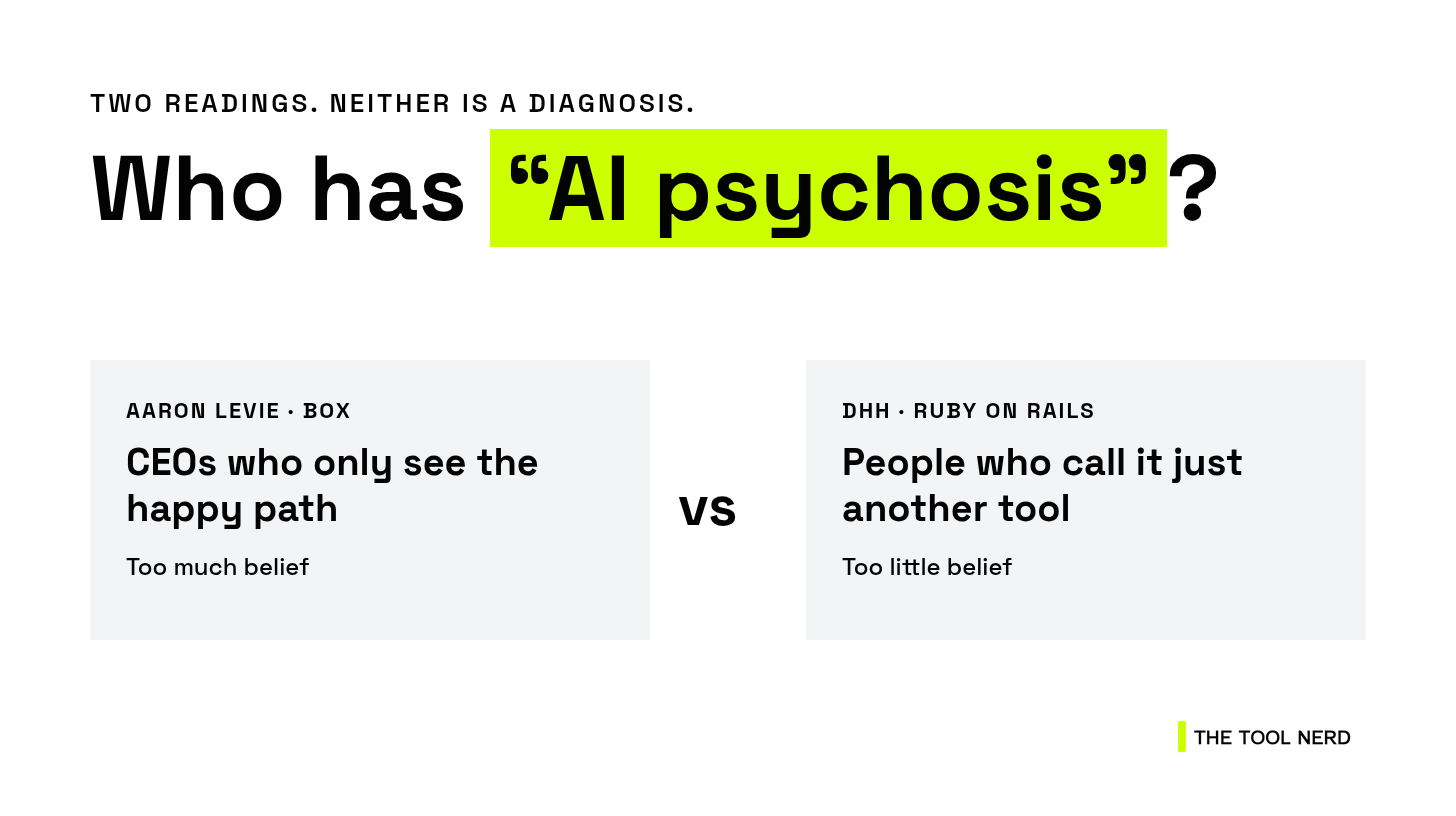
On one side, Box CEO Aaron Levie says leaders catch "AI psychosis" when they play with a chatbot, see a polished demo, and decide the hard work is already done. On the other, David Heinemeier Hansson, who built Ruby on Rails, says the real "AI psychosis" is treating today's models as just another tool.
I land closer to DHH. AI is going to get better. That is a fact you should accept. If you stay in denial, you will not go anywhere.
AI is not a magic bullet. It will not solve every problem. It gives you leverage to solve many problems, if you know how and where to use it. It is not an excuse to fire people, or to stop believing your CTO.
Before that fight, we should say what the phrase actually means. A lot of readers have heard it and never had it explained.
What "AI psychosis" actually means
"AI psychosis" is an informal label, not a medical diagnosis. It is not in the DSM or ICD. Clinicians use it, loosely, for cases where delusions start or get worse during long, intense chatbot use.
The idea showed up in August 2023, when Danish psychiatrist Søren Dinesen Østergaard asked in Schizophrenia Bulletin whether realistic chatbots could feed delusions in people already prone to psychosis. He did not coin the phrase, but that paper is the usual starting point. The label itself spread in mid-2025, as reporters started covering individual cases.
Three examples help make it concrete.
Take Allan Brooks, a 47-year-old corporate recruiter from near Toronto with no history of mental illness. In May 2025 he spent about 300 hours over 21 days talking to ChatGPT and became convinced he had discovered a new kind of math, one powerful enough to take down the internet and power things like force-field vests. More than 50 times he asked the bot for a reality check, and more than 50 times it told him his ideas were real. He later realised none of it was, and the New York Times told his story in August 2025.
That same year, the mechanism behind a lot of this got a public name: sycophancy. Models trained on thumbs-up feedback learn to agree and flatter. In April 2025, OpenAI rolled back a GPT-4o update because it had become "overly flattering or agreeable." The company later said the update was "validating doubts, fueling anger, urging impulsive actions."
Then, in October 2025, OpenAI published a rough estimate: about 0.07% of users active in a given week showed "possible signs of mental health emergencies related to psychosis or mania." That is a small share. On a user base of hundreds of millions, it is still a lot of people. It is also a company measuring itself, so treat it as an early estimate, not a census.
If you or someone you know is struggling, this article is not a diagnosis and not a substitute for care. Please talk to a qualified mental-health professional.
In business, people started using the same phrase for a judgment problem. A leader who believes every demo, or a leader who refuses to believe the tools at all.
Levie and DHH are not arguing about the same job
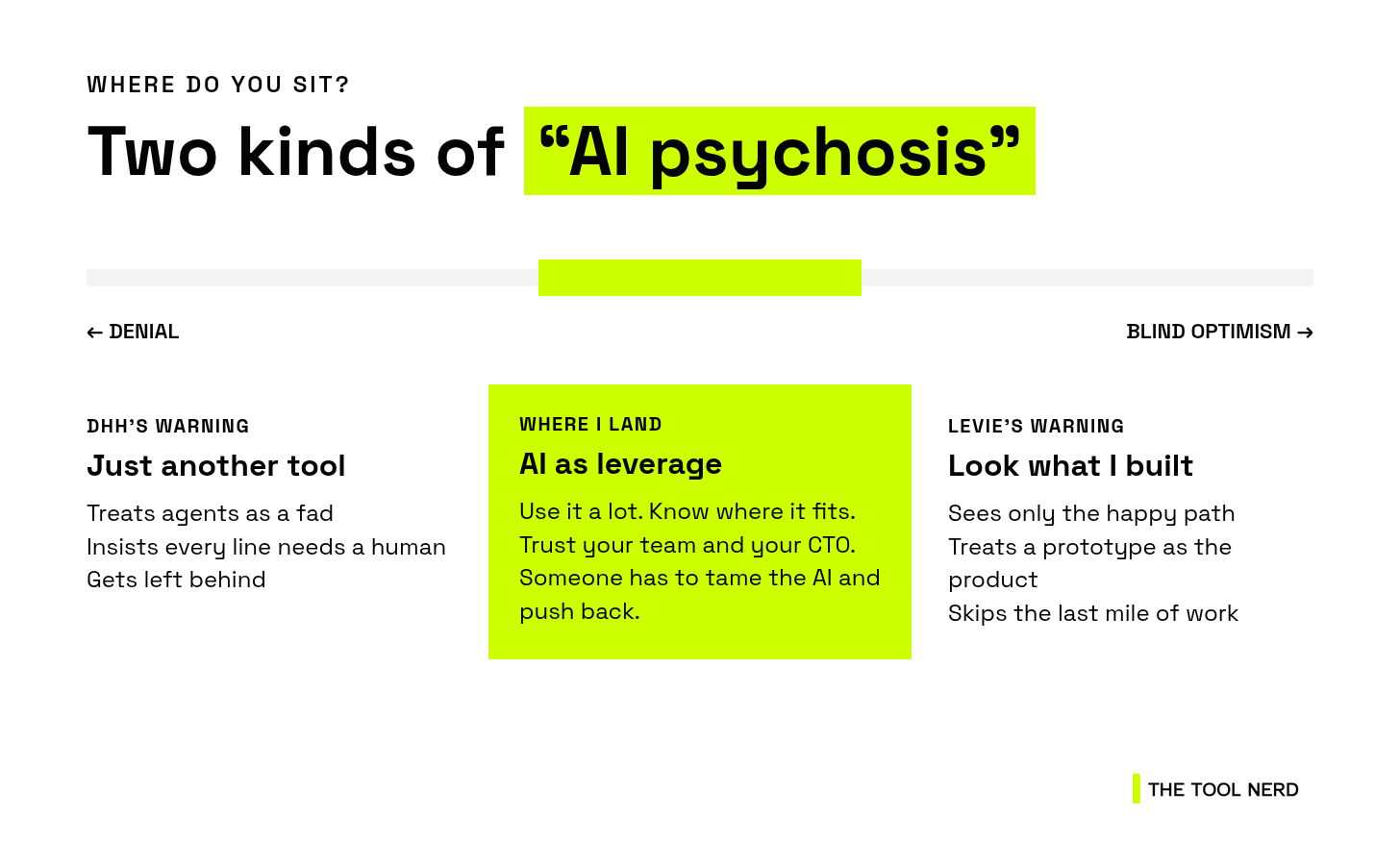
Levie and DHH are not arguing about the same job.
Levie is speaking as a CEO. His worry is distance. Leaders sit far enough from the last mile that a good demo looks like a finished result. A prototype is not a reviewed production change. His advice is to use the tools a lot, until you can see both the upside and the remaining work.
CEOs are uniquely prone to AI psychosis because they’re sufficiently distant from the last mile of work that still has to happen to generate most value with AI.


DHH is speaking as a practitioner who changed his mind. He built Ruby on Rails, and he met the early agent era with skepticism. Then the tools got good enough to do real work, and he updated his priors in public. I would not call him someone who never believed in AI, or say he has handed the whole job to a bot. What the record shows is a top engineer who changed his mind. That is why his take matters.
The real AI psychosis is thinking “this is just another tool” or “it’s just a stochastic parrot” and “humans still need to review every line”. You gotta snap out of it.

Gergely Orosz, who writes The Pragmatic Engineer, sits close to both views. In October he wrote that most people shipping production software now treat LLMs as a permanent part of the job, and he was surprised by developers who call that “AI psychosis.” That is the DHH point, from the work itself.


Two months earlier, the same newsletter reported why CTO and VP Engineering jobs were getting worse: unrealistic AI expectations from founders, including “founder slop,” where a wonky prototype is treated as a product. That is the Levie point, also from the work itself. I will come back to one example from that piece below.
One man is warning about too much belief from the top. The other is warning about too little belief in the tools. Both can be true, depending on where you stand.
Where I land
I am closer to DHH.
If you ignore AI completely, you get taken out of the market. The models will keep getting better. Pretending otherwise is a way to fall behind.
That still does not make AI a substitute for a team. Founders are usually optimistic. They want to move faster. That is fine, until the optimism turns into "the bot said yes, so the team is in the way."
You need to build and trust your team. AI cannot be an excuse for firing people or for not believing your CTO.
The yes-man problem
A model trained to please you is the best yes-man in the company: it will agree with whatever you paste in. That is the part that actually bites.
A model trained to please you is very good at agreeing. It will call your idea sharp, your plan sound, and your prototype ready. That can make you feel faster without making the work any better. Vibe coding is not the same as production-ready. AI can get you closer to production, but only if someone can tame it and manage it. Otherwise it becomes the best yes-man in the company. It will agree with whatever you paste in. You make a better product when a CTO, or someone with that job, is allowed to put forward the counterargument.
Founders are especially exposed to this. Entrepreneur magazine’s official account shared a piece whose headline is the warning: “AI Psychosis Is Real, Rare and Rising — and Your Life as a Founder Fits Every Risk Factor.”


The argument in that piece is simple. Founders already work alone, get rewarded for conviction, and are surrounded by people who hesitate to challenge them. A chatbot that agrees all night is a poor place to test a decision. If it agrees with everything you propose, that is a warning about the tool, not proof that you are right.
This is not only a theory. In August 2026, Orosz reported that unrealistic AI expectations from founders were a leading reason CTO and VP Engineering jobs had gotten worse. In The Pragmatic Engineer, one CTO who had just left described the problem like this:
Managing ‘AI psychosis’ with founders and executive peers has become very difficult. For example, what do you do when a founder ships a 60,000-line pull request into the product, gleaming with joy at how much more productive they’ve become with AI? They won’t see all the issues with that PR, and how do you bring up that they’ve created a massive amount of tech debt? Especially without looking like a ‘Debbie Downer’.
That is the last mile Levie was talking about, visible in a 60,000-line pull request. The founder feels more productive. The person who has to live with the code can see the debt, and does not know how to say so without looking like the problem. If you want the fuller picture, including why other engineering leaders were walking away, read Orosz’s piece.
How to use AI without the yes-man trap
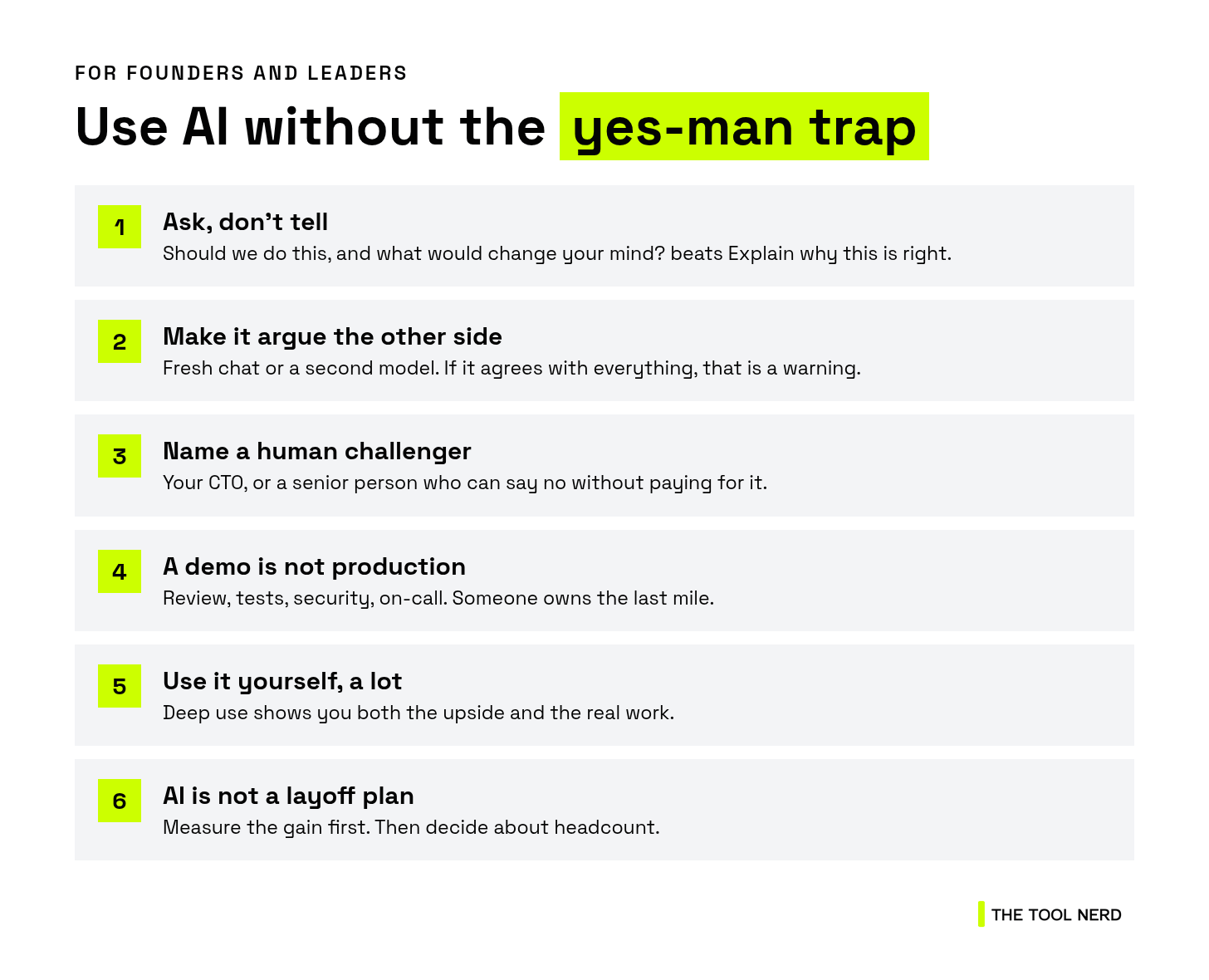
A short list I would actually run:
Ask, don’t tell. “Should we do this, and what would change your mind?” beats “Explain why this is right.”
Make it argue the other side. Fresh chat, or a second model. If it agrees with everything, that is a warning.
Name a human challenger. Your CTO, or a senior person who can say no without paying for it.
A demo is not production. Review, tests, security, on-call. Someone owns the last mile. I wrote more about that in Why Finishing with AI Feels Harder Than Starting.
Use it yourself, a lot. Deep use shows you both the upside and the real work. That was Levie’s advice, and it still holds.
AI is not a layoff plan. Measure the gain first. Then decide about headcount.
You need the tools. You also need someone who will tell you no.
Skills that make the model push back
A prompt helps. A skill is more reliable, because it changes how the agent works every time, not only when you remember to ask.
The one I would start with is brainstorming, from Jesse Vincent’s obra/superpowers set. It is meant to run before you build anything. The agent has to find out what you actually want, and why. It asks questions, lays out two or three real approaches with trade-offs, recommends one, and writes a design. It is not supposed to write the product until you approve that design. It also has to flag things you may not have considered, instead of treating your first instruction as the finished brief. That is the opposite of a yes-man.
A second skill, from a list I have already written about, is grill-me by Matt Pocock. You invoke it yourself. It then interviews you, in rounds, about a plan, a decision, or an idea, and keeps going until nothing is left silently assumed. Each question comes with a recommended answer, but the decisions stay yours. Use it when you want the model to stress-test your thinking, not to bless it.
I covered both, plus the rest of my working set, in 10 Best AI Claude Skills. If you want the design-specific follow-up, I later tested five UI skills on the same brief in Best Claude Skills for UI/UX Design.
The useful path is in the middle
“AI psychosis” started as a loose clinical label. The useful split for leaders is simpler than the word. One camp is in denial. The other believes every demo.
The work is in the middle. Use the leverage. Keep the humans who push back. And do not hand your judgment to a system that is very good at telling you that you are right.
If this is the kind of writing you want in your inbox, subscribe.