

I’ve watched the social media take on Microsoft and Uber’s AI pullback spread like wildfire. The narrative goes something like this: “Big tech companies are realizing AI is too expensive. They’re cutting costs, shutting down AI coding tools, and going back to hiring normal developers. The AI hype is over.”
This narrative is wrong. It misunderstands the core economics of what is actually happening.
Companies are not retreating from AI. They are retreating from unmetered AI - the phase where nobody tracked costs and everyone assumed the bill would sort itself out. What we are seeing now is a shift from reckless experimentation to strategic discipline.
And the economic principle driving this entire shift - the reason why falling AI costs are paradoxically causing enterprise budgets to explode - is a 160-year-old concept called the Jevons Paradox.
If you want to understand why small, founder-led agencies are positioned to win the next five years while enterprises scramble to fix their procurement models, you need to understand this paradox.
You can check out my previous articles to learn more about AI and AI trends


The Enterprise AI Cost Crisis: Why "TokenMaxxing" Broke the Bank
The Unmetered AI Trap: How Uber and Microsoft Burned Millions
In April 2026, I wrote about The Token Test - explaining why “TokenMaxxing,” where engineers compete on internal leaderboards to consume the most AI tokens, was a vanity metric destined to fail.

That failure arrived faster than expected.
Microsoft cancelled most of its internal Claude Code licenses in its Experiences & Devices division just six months after launching them.
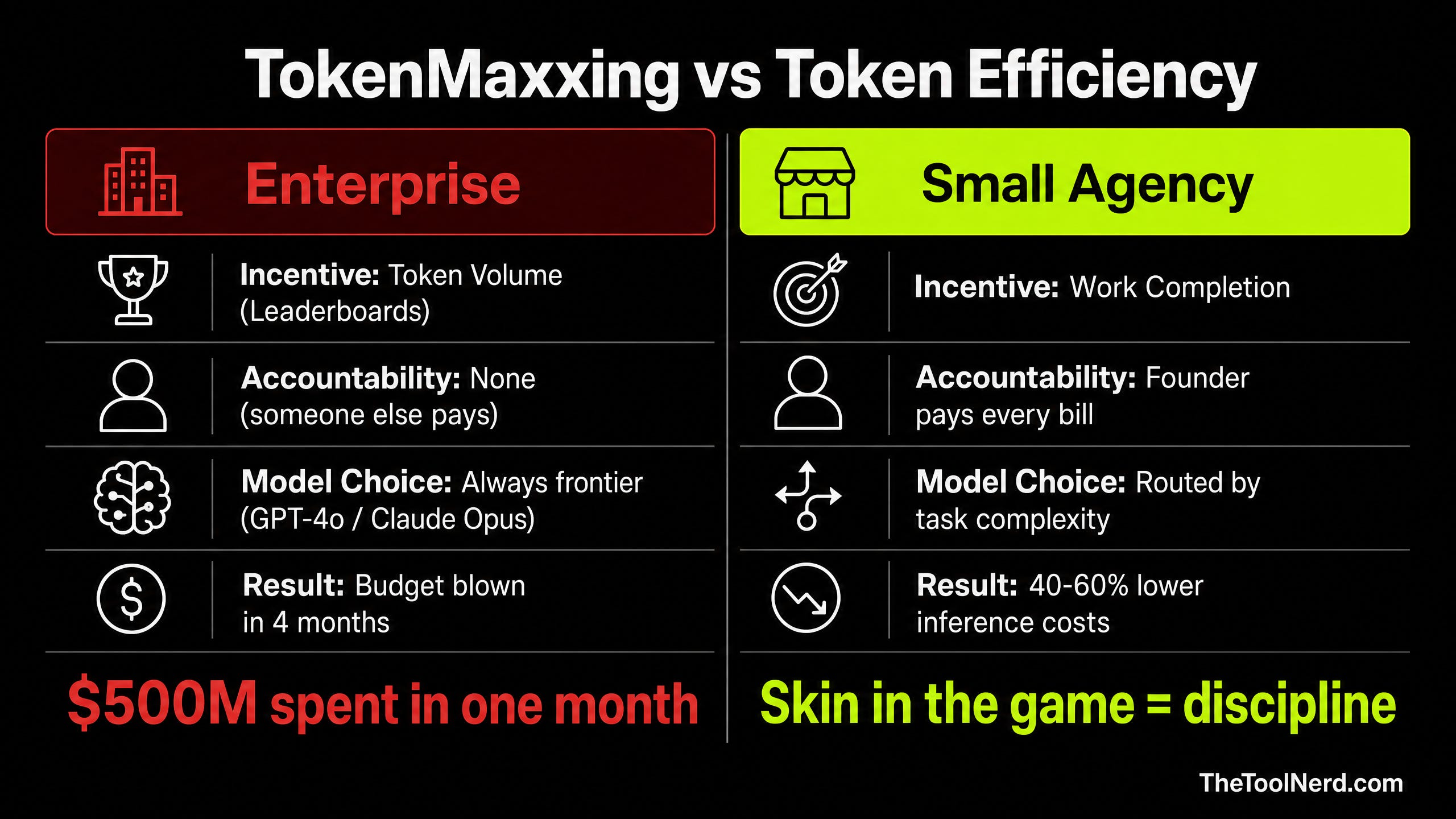
Uber burned through its entire 2026 AI coding budget in just four months - Claude Code adoption jumped from 32% to 84% of their 5,000 engineers, with individual developers spending up to $2,000 per month on tokens.
One unnamed enterprise reportedly spent $500 million in a single month because they failed to set usage limits on their licenses.
The problem is not that the tools don’t work. The problem is that the tools work too well, and the pricing model is fundamentally broken for knowledge work.
When you charge for AI by the token, and you give engineers agentic tools that run autonomous loops, a single request can generate thousands of inference calls. Enterprises handed their teams a corporate credit card with no limit, tied to a metered utility that runs while nobody is looking.
But here is the real puzzle: how did costs explode exactly when the price of AI models collapsed?
What is the Jevons Paradox in AI?
In 1865, English economist William Stanley Jevons published The Coal Question. He observed something counterintuitive: as steam engines became more fuel-efficient, Britain didn’t use less coal. It used far more.
The logic was simple. More efficient engines lowered the cost of doing work with coal. Lower costs made coal-powered applications viable in more industries. More industries adopted steam power. Total coal consumption skyrocketed.
This is the Jevons Paradox: efficiency gains increase total resource consumption rather than reducing it, because they expand the range of economically viable applications.
We saw this with cars - better fuel efficiency led to more driving. We saw this with computing - cheaper storage led to massive data hoarding. Now, we are seeing it with AI tokens.
The AI Cost Collapse: Real Token Pricing in 2026
Here is how dramatically the model pricing landscape has shifted in just three years. GPT-5.5 - OpenAI’s current flagship - costs $5 input / $30 output per million tokens. Claude Opus 4.8 - Anthropic’s latest - sits at $5 input / $25 output. Compare that to GPT-4 in 2023 at $15 input / $60 output, and the collapse is stark.
That is an 80-95% price drop depending on the tier you compare.
Why Cheaper AI Models Drive Total Spending Up
According to standard logic, companies should be spending far less on AI. But that is not what happens when the Jevons Paradox kicks in.
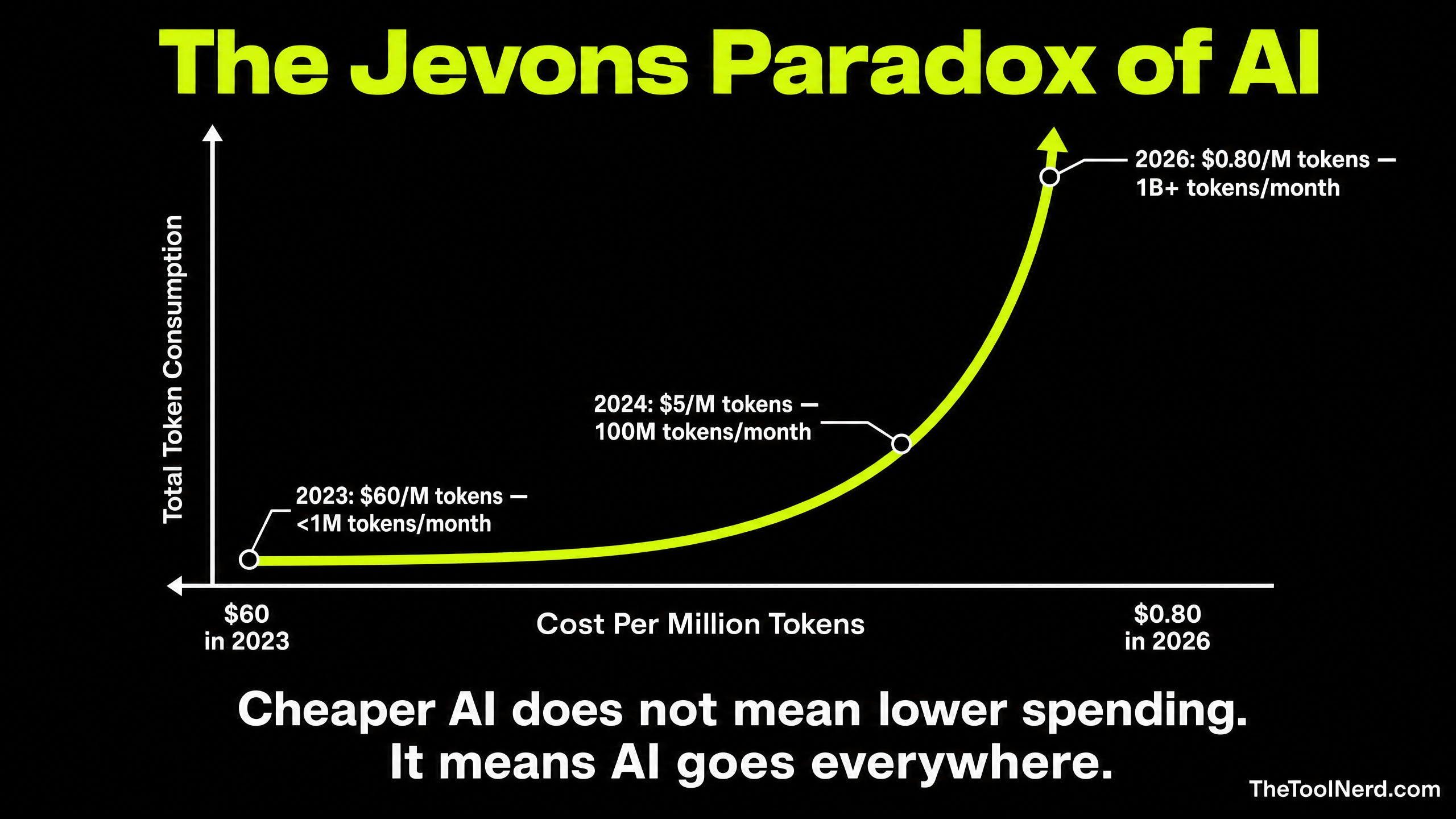
When API costs drop 95%, you don’t spend 95% less. You build 20 times more applications.
When Claude Opus cost $75 per million tokens, you only used it for high-value tasks. At $25 per million - or $0.40 for DeepSeek - the calculus changes completely. Now it is economically rational to run AI analysis on every customer support ticket, generate first drafts of every internal document, and process every data record in your database.
This is why Goldman Sachs projects that token consumption will multiply 24x by 2030. It is why Google processed 3.2 quadrillion tokens in May 2026 alone - a 7x jump from the previous year.
Cheaper AI does not mean lower spending. Cheaper AI means AI goes everywhere.
Token Economics: Why the Social Media Narrative Has It Wrong
This brings us back to the narrative that companies are “moving away” from AI.
Enterprises are not abandoning AI. They are abandoning the pay-as-you-go unlimited token use model for their agentic workflows.
When Uber’s engineers burn $2,000 a month each, the company isn’t going to take the AI away and tell them to code manually again. The productivity loss would be catastrophic. Instead, the procurement model is shifting.
We are moving toward a world of metered access, hard budget caps, and eventually, flat-fee unlimited pricing. Enterprises are realizing that you cannot treat knowledge work like a metered AWS instance. You need predictable costs.
The companies that scale AI successfully over the next two years won’t be the ones that cut usage. They will be the ones that build systems to manage it.
And this is exactly why small agencies might win being more efficient.
How Lean AI Agencies Use Token Efficiency to Win
While enterprises struggle with runaway budgets and misaligned incentives, small, founder-led AI agencies are building the systems of the future.
Why? Because founders have skin in the game.
In a large enterprise, an engineer running an inefficient agent loop doesn’t pay the API bill. In a small agency, every wasted token comes directly out of the founder’s margin. This capital scarcity forces discipline. It forces the agency to build systems that exploit the Jevons Paradox rather than falling victim to it.
Here is the playbook lean AI agencies are using right now:
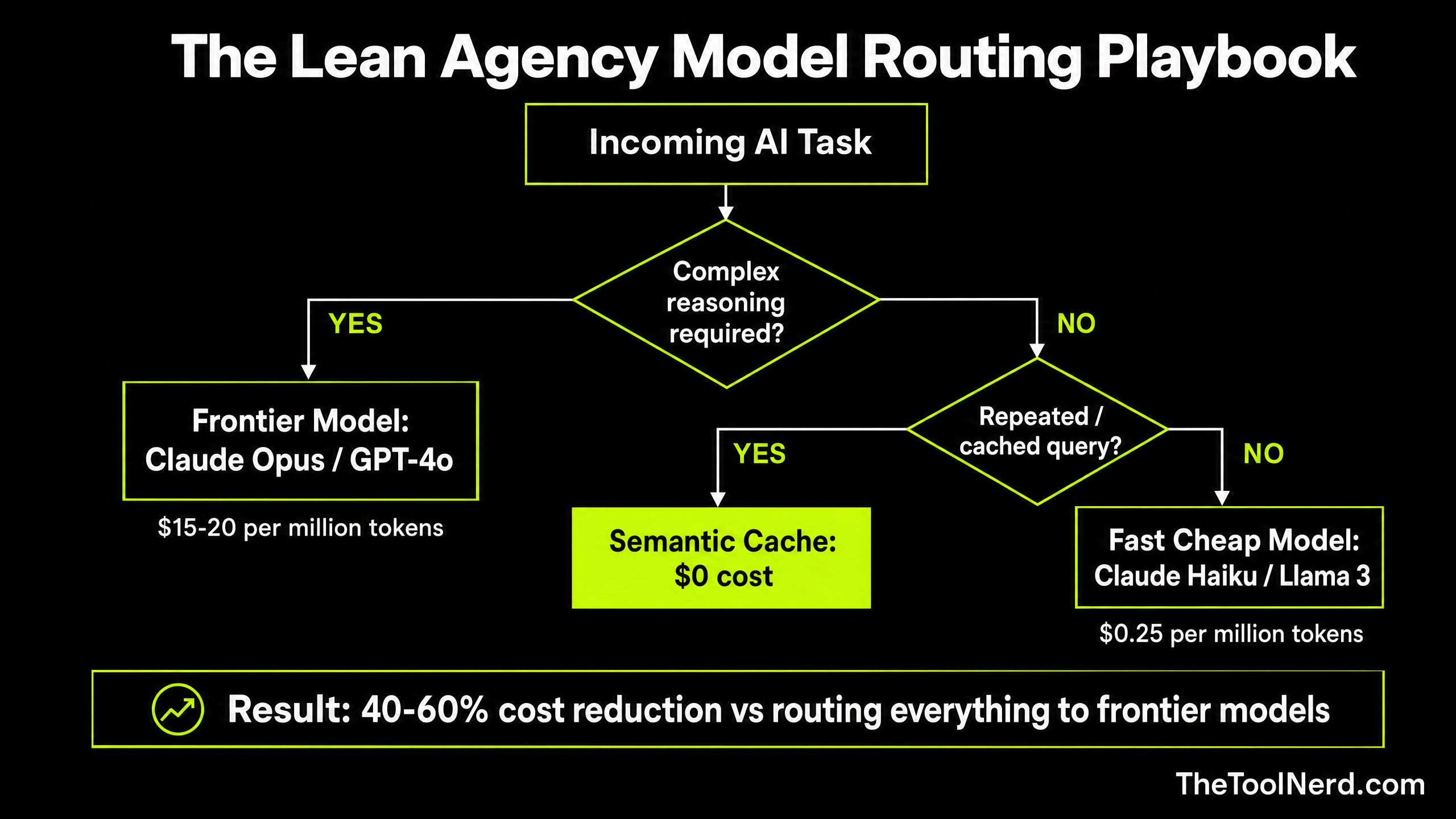
1. Dynamic Model Routing Strategies
Small agencies do not send every request to Claude Opus 4.8 ($25/M output tokens) or GPT-5.5 ($30/M output tokens).
They build routing systems. A simple summarization or data extraction task goes to GPT-5 Mini ($2/M tokens) or Gemini 3 Flash ($3/M tokens).
Only complex reasoning - architecture decisions, nuanced analysis, multi-step code generation - gets routed to the frontier models. This single architectural decision cuts per-request costs by 40-60% without degrading output quality.
2. Prompt and Semantic Caching
If ten users ask an AI agent similar questions, an enterprise system often processes ten identical LLM calls. A lean agency implements semantic caching at the gateway layer. The system recognizes a repeated or near-identical query and serves the cached answer, eliminating the inference cost. Anthropic’s own prompt caching feature can reduce costs by up to 90% on repeated system prompts.
3. Outcome-Based Incentives and the "First Pass Rate"
Enterprises built leaderboards rewarding engineers for consuming tokens. Lean agencies incentivize outcomes. They evaluate engineers on the “First Pass Rate” - the ability to write context so clearly that the AI executes the requirement perfectly on the first attempt, eliminating expensive redo cycles. As I described in The Token Test, this is the skill that separates the next generation of AI-native engineers from everyone else.
4. Setting Strict Inference Budgets for Autonomous Agents
Agent loops are the biggest driver of cost explosions. A poorly designed agent can get stuck in a reasoning loop, burning thousands of calls. Lean teams build hard circuit breakers and per-task inference budgets. If an agent hits $2 of spend on a single task, the system halts it and flags it for review.
The Real ROI of AI is Time Compression, Not Headcount
The fundamental mistake enterprises made was expecting AI to deliver linear cost savings. They looked at an AI coding tool and thought: this will let us fire half our engineers and save 50% on payroll.
That is not how the math works.
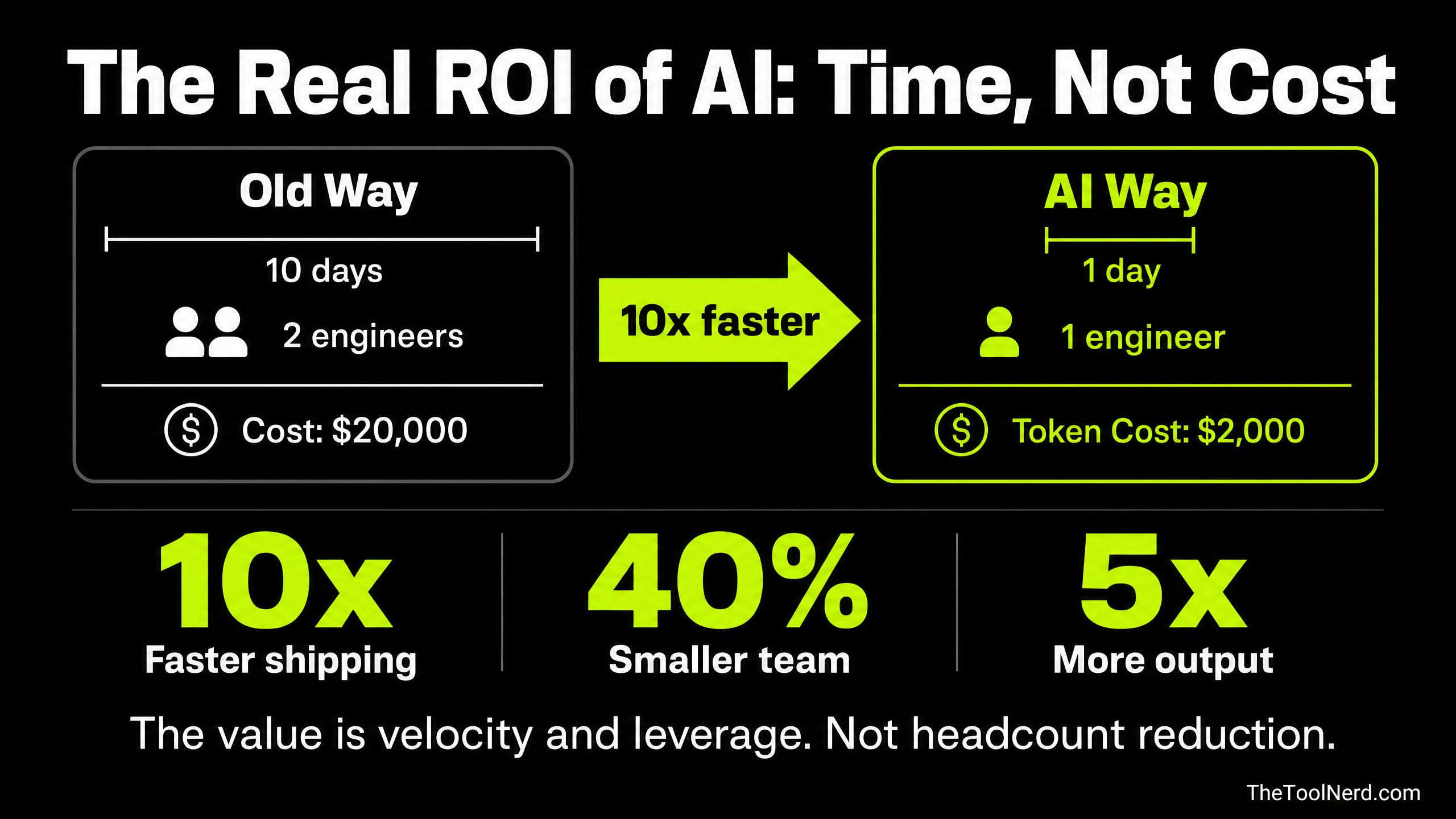
The real promise of AI is time compression and velocity.
A feature that used to take 10 days with two engineers might now take 1 day with one engineer using Claude Opus 4.8 or GPT-5.5 in an agentic loop. But the token cost during that single day of agentic coding might run $1,500-$2,000 in API spend. You didn’t save 50% of your costs. You saved maybe 10-20%. But you shipped the feature 10x faster.
The value is not cheaper code. The value is faster shipping, fewer bottlenecks, and smaller teams delivering more. Small agencies understand this intuitively. They use AI for leverage. Enterprises are still trying to use it for headcount reduction, and they are getting burned by the token bills.
The Verdict
The TokenMaxxing era is over. The days of burning tokens as a vanity metric are ending.
But AI is not retreating. Thanks to the Jevons Paradox, as models like GPT-5.5, Claude Opus 4.8, and Gemini 3 Pro get cheaper and faster, they will embed themselves deeper into every workflow, every product, and every industry. The total consumption of intelligence will only increase.
The winners in this next phase will not be the companies with the biggest budgets. The winners will be the lean, founder-led teams who understand token economics. The developers who know when to use GPT-5.5 and Claude Opus 4.8 for hard problems, and when to route everything else to the $2/M models.
The future belongs to those who can pass the Token Test.
References
[1] The Token Test - TheToolNerd: https://www.thetoolnerd.com/p/the-token-test-how-the-best-companies
[2] LLM API Pricing Comparison June 2026 - CostGoat: https://costgoat.com/compare/llm-api
[3] Best AI Models June 2026 - Overchat AI: https://overchat.ai/ai-hub/the-best-ai-model
[4] Goldman Sachs Token Consumption Projection (24x by 2030): Goldman Sachs Global Investment Research, 2025
[5] Jevons Paradox in AI - Mindstudio: https://www.mindstudio.ai/blog/jevons-paradox-ai-cheaper-models-more-jobs/
[6] Enterprise AI Cost Crisis - SmarterX: https://smarterx.ai/smarterxblog/ai-costs-exploding-at-enterprise