

In the previous blogs, we explored how Artificial Intelligence can be used to generate Process FMEA (PFMEA) and Manufacturing Control Plans within minutes. PFMEA identifies potential failures in the process. The Control Plan defines how those risks will be monitored and controlled. The Standard Operating Procedure (SOP) is the final execution layer that translates engineering intent into clear step-by-step instructions for operators on the shop floor.
In this article, we will see how AI can generate a complete Standard Operating Procedure using PFMEA and Control Plan as inputs, while ensuring alignment with international manufacturing and safety standards.
SOP: The Execution Backbone of Manufacturing Quality
A Standard Operating Procedure (SOP) is a documented instruction that defines how a manufacturing process must be executed to ensure:
• Product quality
• Process consistency
• Operator safety
• Regulatory compliance
• Standardized training
An SOP converts engineering requirements into practical shop-floor actions. In modern manufacturing systems, SOPs are essential for compliance with global standards such as:
• ISO 9001 – Quality Management Systems
• IATF 16949 – Automotive Quality Management
• ISO 45001 / OHSAS 18001 – Occupational Health & Safety
• ISO 14001 – Environmental Management
• OSHA Safety Regulations
• AIAG Manufacturing Standards
These standards require organizations to define controlled work instructions and documented procedures to ensure consistent process execution.
Relationship Between PFMEA, Control Plan and SOP: The Manufacturing Quality “Golden Thread”
A properly designed manufacturing documentation system follows a clear hierarchy. This interconnected system forms what we call the “Manufacturing Quality Golden Thread.”
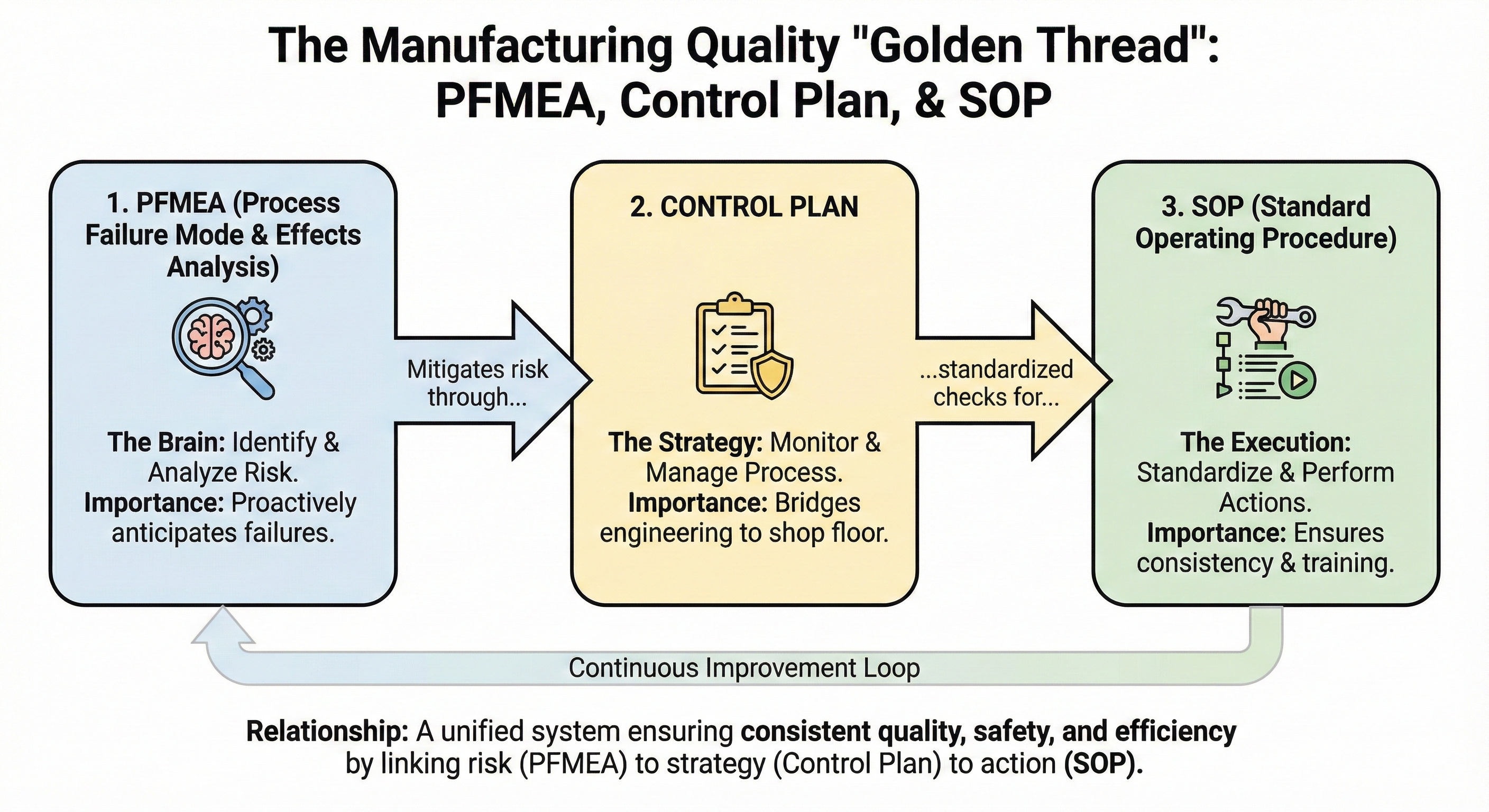
PFMEA (Process Failure Mode & Effects Analysis) – Identifies potential process failures.
Control Plan – Defines the monitoring and control methods for the process.
SOP (Standard Operating Procedure) – Defines how operators execute the process on the shop floor.
Example:
• PFMEA identifies a failure mode: Diameter exceeds tolerance
• Control Plan defines the control: Measure diameter every 10 parts using micrometre
• SOP converts this into operator instruction: After machining every 10th component, measure the diameter using a calibrated micrometer and record the value in the inspection log.
Thus, the SOP ensures the Control Plan is actually executed on the shop floor.
If you would like to learn about Creating FMEA && Control Plan with AI checkout these previous articles


Step-by-Step Method Using AI
Step 1: Login to ChatGPT or any advanced AI tool.
Step 2: Upload the following documents
• PFMEA
• Control Plan
• Engineering Drawing (optional but recommended)
Step 3: Write a structured prompt
Just like PFMEA and Control Plan, prompt quality determines output quality. A vague prompt gives generic instructions. A detailed prompt generates industry-ready SOPs.
Example Instruction for AI SOP Generation
You are a manufacturing process expert in making SOPs. Create a Manufacturing Standard Operating Procedure (SOP) for a rough turning operation using the attached PFMEA and Control Plan as reference inputs.

The SOP must align with internationally accepted manufacturing and safety standards including:


• ISO 9001:2015 – Quality Management System documentation requirements

• IATF 16949 – Automotive manufacturing process control

• ISO 45001 / OHSAS 18001 – Occupational Health & Safety

• OSHA machine safety guidelines

• AIAG manufacturing documentation practices

# Process Details

• Operation: Rough Turning

• Objective: Achieve diameter Ø50 mm over 80 mm length

• Raw Material: Steel rod Ø60 mm × 111 mm (+1 mm)

• Machine Type: CNC Lathe (Semi-automatic)

• Operator Skill Level: Skilled operator

The SOP must include the following structured sections:


1. Purpose

2. Scope

3. Applicable Standards and References

4. Roles and Responsibilities

5. Safety Requirements

6. Required Tools and Equipment

7. Raw Material Requirements

8. Machine Setup Procedure

9. Step-by-Step Operating Instructions

10. In-Process Quality Controls aligned with Control Plan

11. Reaction Plan for Non-Conformance

12. Documentation and Record Keeping

13. Shutdown Procedure

14. Training and Competency Requirements


# Alignment Requirements

• SOP must reflect PFMEA identified risks and controls.

• Inspection steps must match the Control Plan inspection frequency.

• Critical process parameters must be highlighted.

These include:

• Cutting speed

• Feed rate

• Depth of cut

• Tool wear monitoring

• Coolant flow


# Formatting Requirements

• SOP must be written in clear shop-floor language.

• Instructions must be step-by-step and numbered.

• Safety warnings must be clearly indicated.

• The SOP should be suitable for training operators and for external audits.

If any assumptions are required due to incomplete information, list them clearly.
Example AI Generated SOP
SOP Title: Standard Operating Procedure - Rough Turning Operation – Steel Rod
1. Purpose
This procedure defines the standardized method for performing the rough turning operation on a steel rod to achieve the required diameter and length while ensuring product quality, operator safety, and compliance with international manufacturing standards.
2. Scope
This SOP applies to all CNC lathe operations performing rough turning for the specified component. Applicable departments include: Production, Quality Assurance & Maintenance.
3. Applicable Standards and References
This SOP aligns with the following standards:
• ISO 9001 – Quality Management Systems
• IATF 16949 – Automotive Manufacturing Quality
• ISO 45001 – Occupational Health and Safety
• OSHA Machine Safety Regulations
• AIAG Manufacturing Process Standards
4. Responsibilities
• Production Operator
– Execute machining operations according to SOP
– Perform in-process inspections
– Report deviations
• Quality Inspector
– Verify dimensional conformity
– Conduct process audits
• Production Supervisor
– Ensure trained operators execute the process
5. Safety Precautions
Operators must follow these safety requirements:
• Wear safety goggles and safety shoes
• Ensure machine guards are closed before operation
• Keep hands away from rotating components
• Use chip removal brush instead of hands
• Stop machine before inspecting tools
Emergency stop button location must be known before operating the machine.
6. Required Tools and Equipment
• Machine: CNC Lathe
• Cutting Tool: Carbide turning insert
• Measuring Instruments: Digital micrometer / Vernier caliper
• Other Equipment: Coolant system, Chip removal brush
7. Raw Material Requirements
• Material: Steel rod
• Dimensions:
– Diameter: Ø60 mm
– Length: 111 mm (+1 mm)
Material must be inspected for: Surface damage, Rust, Bending.
8. Machine Setup Procedure
1. Switch on the CNC machine.
2. Load the machining program.
3. Install the turning insert tool.
4. Set tool offsets.
5. Check coolant supply.
6. Mount raw material securely in chuck.
7. Perform a dry run without cutting.
9. Operating Procedure
Step 1: Load raw material into chuck.
Step 2: Secure chuck jaws.
Step 3: Start spindle rotation.
Step 4: Initiate rough turning cycle.
Step 5: Machine rod to achieve approximately Ø50 mm diameter over 80 mm length. Step 6: Ensure coolant flow during machining.
Step 7: Monitor chip formation and cutting sound.
Step 8: Unload finished component.
10. In-Process Quality Checks
• Characteristic: Diameter Ø50 mm
• Measurement Method: Digital Micrometer
• Inspection Frequency: Every 10 components
Results must be recorded in inspection sheet.
11. Reaction Plan
If dimension exceeds tolerance:
1. Stop machine immediately.
2. Inspect tool wear.
3. Adjust tool offset.
4. Re-machine next component.
5. Inform supervisor if issue persists.
12. Documentation
Operators must record:
• Production quantity
• Inspection results
• Machine downtime
• Tool changes
13. Shutdown Procedure
Stop the spindle.
Remove workpiece.
Clean machine bed.
Switch off coolant system.
Turn off machine.
14. Training Requirements
Operators must be trained in:
CNC machine operation
Measuring instruments
Safety procedures
Control Plan compliance
Final Thoughts
Using AI tools, a complete manufacturing SOP can now be generated within minutes. Instead of spending several days preparing documentation manually, engineers can now focus on process optimization and continuous improvement.
When integrated properly, AI can generate the entire manufacturing documentation stack:
PFMEA
Control Plan
Standard Operating Procedure
Work Instructions
Operator Training Material
This represents a major leap in how manufacturing organizations approach quality documentation and process standardization.
Thank You for sharing this. All the 3 articles are worth its weight in Gold. As Rightly stated, this is a golden thread not just for manufacturing but also for services industry.
I am simply amazed that it we include the correct AI Techniques, it is producing accurate output in no time.