

What Just Happened
February 14, 2026: Peter Steinberger, the Austrian developer behind OpenClaw (formerly Clawdbot, briefly Moltbot), announced he’s joining OpenAI.

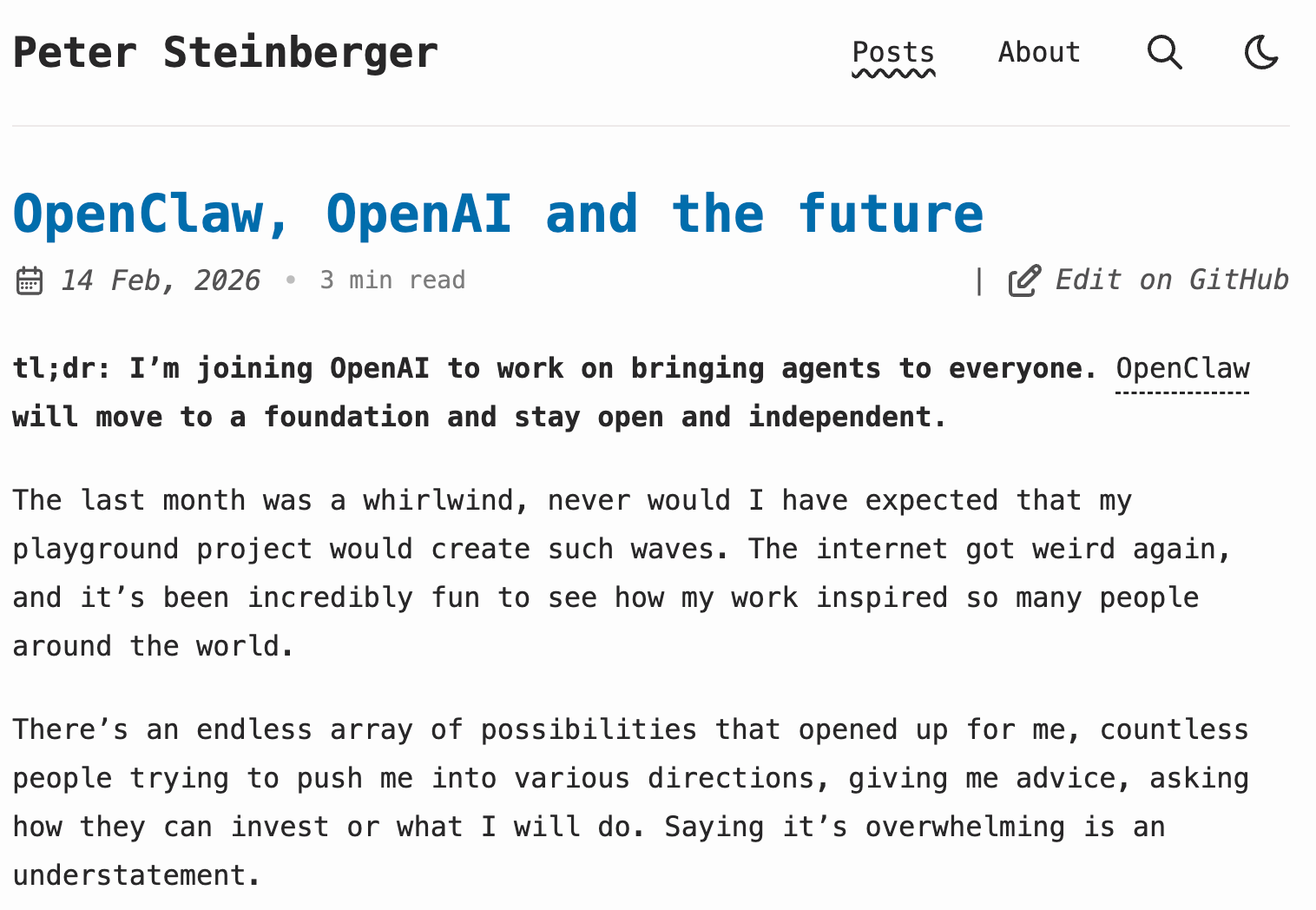
February 16, 2026: OpenAI CEO Sam Altman confirmed the hire on X, stating Steinberger will “drive the next generation of personal agents.”

What is OpenClaw?

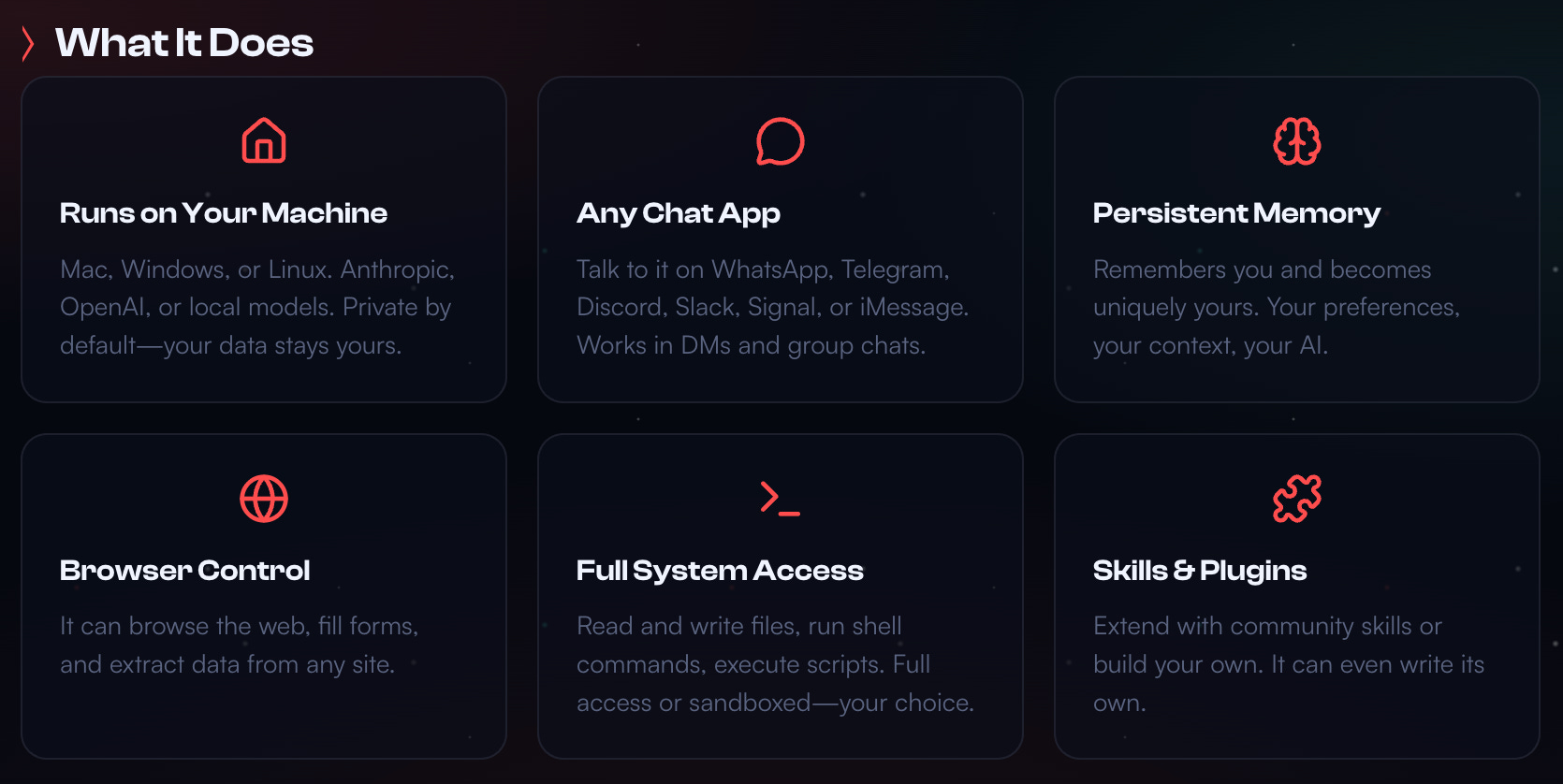
OpenClaw is an open-source AI agent framework that connects AI models to your real-world tools — email, calendars, Slack, web browsers, and more — so the AI can actually do things, not just chat.
The simple version: You give it natural language commands like "check my calendar for tomorrow and email the team the agenda," and it executes the whole workflow autonomously.
Key features:
• Multi-tool orchestration — chains email, messaging, CRMs, browsers, calendars together
• Error handling & caching — manages state across long workflows
• Self-hostable — run it on your own infrastructure
Why it blew up: Steinberger shared demos of OpenClaw running real workflows through a simple chat interface, coordinating multiple tools from a single conversation. It gave people a concrete glimpse of what “AI agents that actually do things” could look like.
It's not another chatbot wrapper. It's an orchestration layer that handles authentication, API calls, error recovery, and parallel execution across multiple services
OpenClaw Growth Numbers
By the Numbers
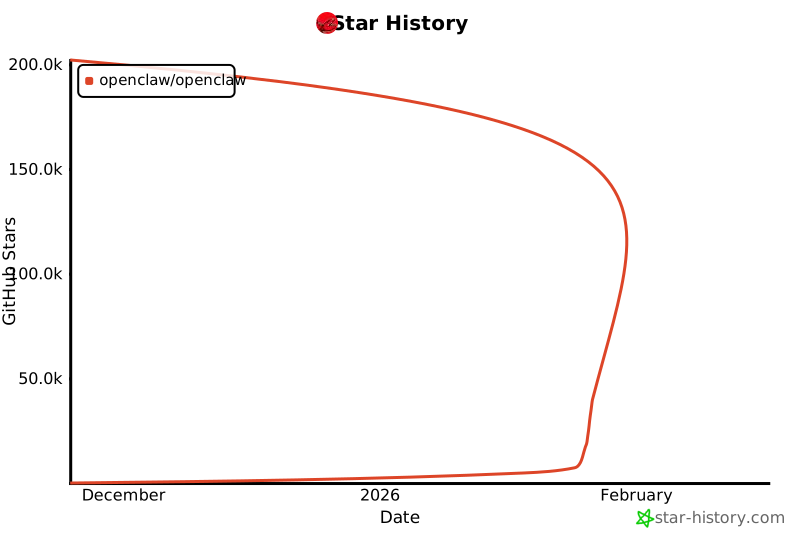
GitHub Stars: > 200,000
Forks: 36K
Monthly Losses (personal subsidy): $10,000–$20,000
Acquisition Offers: Interests from Meta and OpenAI
Time to Viral: ~3 months (Nov 2025 – Feb 2026)
Previous Names: Clawdbot → Moltbot → OpenClaw
The Timeline
November 2025: Steinberger open-sources Clawdbot
January 2026: Anthropic raised trademark concerns over name similarity to Claude
Late January 2026: Rebrands to Moltbot, then quickly to OpenClaw
February 14, 2026: Announces OpenAI move
February 15, 2026: Altman confirms; OpenClaw to become a foundation
If you would like to setup and try it out yourself, check out my previous article and also read how people have built wrappers around it and minting money


Why Steinberger Chose OpenAI
Steinberger had options :
Offers from major tech companies, including Meta
Pursuing a new venture-backed startup
Potentially significant financial upside
What he chose instead was joining OpenAI to focus on advancing AI agents at global scale.
Four reasons why he decided to join OpenAI
Not interested in running a company
He’s done the company thing and wasn’t interested in doing that again. For him it was all about the bigger goal.
“I poured 13 years into my last company. What I want is to change the world, not build a large company.”
Mission match
Both sides believe AI agents are the next platform after smartphones.
Access
Direct exposure to frontier research and collaboration with leading researchers.
Speed
“Teaming up with OpenAI is the fastest way to bring this to everyone.”
“I’m a builder at heart… What I want is to change the world, not build a large company.”
What Happens to OpenClaw?
Good News for Open Source
OpenClaw will become a foundation (non-profit)
Will remain open source and independent
OpenAI will continue supporting the project
Steinberger will remain involved
Steinberger’s Words:
“It’s always been important to me that OpenClaw stays open source and given the freedom to flourish. Ultimately, I felt OpenAI was the best place to continue pushing on my vision and expand its reach.”
The Real Question
Will users trust OpenClaw with sensitive workflows now that it’s linked to OpenAI?
Historical Context
It’s not the first time an open-source project thrived alongside strong corporate involvement. Some of the most critical infrastructure in tech followed this path:
Linux: started by Linus Torvalds, heavily backed by companies like IBM, Intel, and Red Hat — became the foundation of modern computing and the backbone of the cloud.
Kubernetes: created at Google and donated to the CNCF with neutral governance is now the industry standard for container orchestration.
PostgreSQL: supported by multiple companies and a strong foundation remains one of the most trusted open-source databases in production.
VS Code: developed and open-sourced by Microsoft became the most widely used developer editor globally while maintaining a vibrant extension ecosystem.
Rust: originally incubated at Mozilla and now governed by the Rust Foundation -continues to grow as a major systems programming language adopted by companies like Microsoft, Amazon, and Google.
Strong governance and community ownership have historically allowed open-source projects to thrive even when closely tied to large organizations.
OpenClaw could become the Linux of AI agents if the foundation works.
The real story isn’t whether OpenClaw stays open source — it’s whether agent infrastructure becomes a new battleground between open ecosystems and platform companies.
Let’s see!